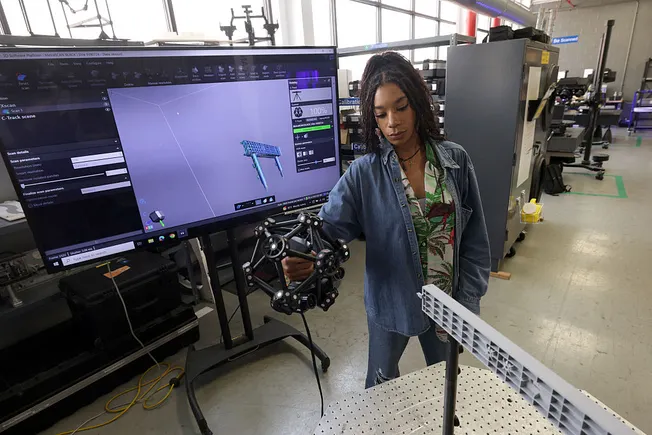
When does the compensable workday begin and end for remote employees? The answer is evolving.
Frank B. Shuster is a partner at law firm Constangy, Brooks, Smith & Prophete, focusing on traditional labor law, employment litigation and appellate work.
According to recent studies, more than one-third of all employees in the U.S. work remotely one or more days a week. Many do so by using computers and working with employer-provided software and applications.
This phenomenon requires employers to develop rules for determining and documenting when a remote employee’s workday begins and ends.
For example, an employer could adopt a rule that compensable time begins when the employee turns their computer on at the start of their shift and ends when they log off at the end of their shift, with 30 minutes for an unpaid meal break.
An employer also could adopt a rule that compensable time: 1) begins after the employee has turned on their computer, logged in, completed all authentication procedures and started interacting with the software programs and applications required to do their jobs; 2) ends when they stop interacting with those programs and applications (rather than when they log out); and 3) includes a 30-minute unpaid meal break.
Both require an additional rule prohibiting “off-the-clock” work and an employer who ensures compliance with that rule.
You may be asking — who cares about five or 10 minutes of start-up/log-in time at the beginning of a shift and five or 10 minutes of shut-down/log-out time at the end?
I will answer that with song lyrics that reveal my age.
The 1950s Broadway musical “The Pajama Game” was a guy-meets-girl, guy-loses-girl, guy-gets-girl-back love story about a group of factory workers trying to get a raise. One of its songs, “7 ½ Cents,” has the following lyrics written by Richard Adler and Jerry Ross: “Seven and a half cents doesn’t buy a hell of a lot/Seven and a half cents doesn’t mean a thing/But give it to me every hour/Forty hours every week/That’s enough for me to be livin’ like a king.”
Factoring in inflation since the 1950s, 7 ½ cents an hour is equivalent to almost $1 an hour today.
Ten or 20 minutes a day, multiplied by 200-plus workdays a year, multiplied by hundreds or thousands of employees, likely adds up to a check an employer would not want to write, especially when adding in the other available recoveries.
The framework for separating compensable and noncompensable activities
The 1949 Portal-to-Portal Act includes a provision that exempts employers from having to pay employees for activities that are preliminary to or postliminary to the employees’ principal activities.
An employee’s principal activities include all activities integral and indispensable to the performance of those activities.
Based on the accepted definitions of those two words: 1) an integral activity is one that forms an intrinsic portion or element of the activity itself, as distinguished from being an adjunct or appendage; and 2) an indispensable activity is one that cannot be dispensed with or disregarded when performing an activity.
With that as the basic framework, the question becomes: Are activities like booting up a computer, logging in and completing dual-factor authentication integral and indispensable to an employee’s performance of duties working with their employer’s software and computer applications?
The current answer depends on where the employee lives or works, and a universal answer is yet to be determined.
The beauty (or the challenge) of our federal court system
The U.S. judiciary has 12 geographically distinct federal appeals court circuits. Decisions from one appeals court are not binding on the courts in another circuit. When conflicts arise between appellate court decisions, the U.S. Supreme Court may resolve them, establishing a single standard that applies nationwide.
Recently, a federal trial court judge in Ohio established bright-line rules about compensable time for remote employees whose principal duties involved working with their employer’s software programs and applications.
The judge concluded that turning on a computer, entering a username and password, completing dual-factor authentication, opening the timekeeping system and accessing a VPN on the front end and then shutting down the computer, locking the screen or putting it in sleep mode on the back end are not compensable activities. However, once those tasks are complete, all time spent opening and working with the software and applications necessary for the employees’ job duties is compensable, the judge said.
While the judge found that the start-up/shut-down activities were indispensable to the employees’ ability to perform their primary activities because they had to access those systems to perform those duties, the start-up/shut-down activities were not integral to the performance of activities involving the software and applications.
In contrast, the U.S. Circuit Courts of Appeals for the 9th and 10th Circuits — which include 14 western states — have reached an opposite conclusion, holding that these types of start-up/shut-down activities are both indispensable and integral and are therefore compensable.
In the Ohio case, the 6th Circuit recently granted a rare appeal of the judge’s decision. If the 6th Circuit agrees with the district court and parts ways with the 9th and 10th Circuits, there will be a split between the circuits. While that doesn’t guarantee Supreme Court review, it would be a step in that direction.
Additionally, if the 6th Circuit reverses the district court’s order and follows the rationale of the 9th and 10th circuit cases, it will lend additional support to the argument that all such activities are compensable.
What’s an employer to do?
That depends on where your employees live and work and your tolerance for risk.
But, at a minimum, an employer should identify 1) the activities that are indispensable and integral to its employees’ principal activities and 2) the activities that are preliminary and postliminary to them.
The former are compensable. The latter are not.