Enterprise Automation Platforms: A Governance Guide
ARTICLE SUMMARY
An enterprise automation platform is software that lets an organization build, run, and govern automated workflows and AI across teams and systems. For IT leaders, the decisive question is not how fast it automates, but how well it governs: audit trail, access control, model control, and human oversight.
By Sobhan Daliry, Chief Product Officer (CPO) at Pipefy
In my work leading product at Pipefy, I have sat through a lot of platform evaluations, and most of them start in the wrong place. The demo is impressive, a workflow gets built in minutes, and the shortlist forms around whichever tool feels fastest. Speed is easy to see in a sales call, so it dominates the scorecard.
For a governed enterprise, that is exactly the trap. Automation that IT cannot see, scope, or audit does not reduce risk, it multiplies it, one fast workflow at a time. The platforms that matter at enterprise scale are the ones that make automation governable, not just quick.
In this guide I want to reframe the evaluation around governance. It covers what an enterprise automation platform actually has to do for an IT-governed business, why speed is the wrong headline criterion, the governance checklist I would score against, a side-by-side view of governance-first versus automation-first approaches, the questions to ask before rollout, and how we approach each requirement at Pipefy.
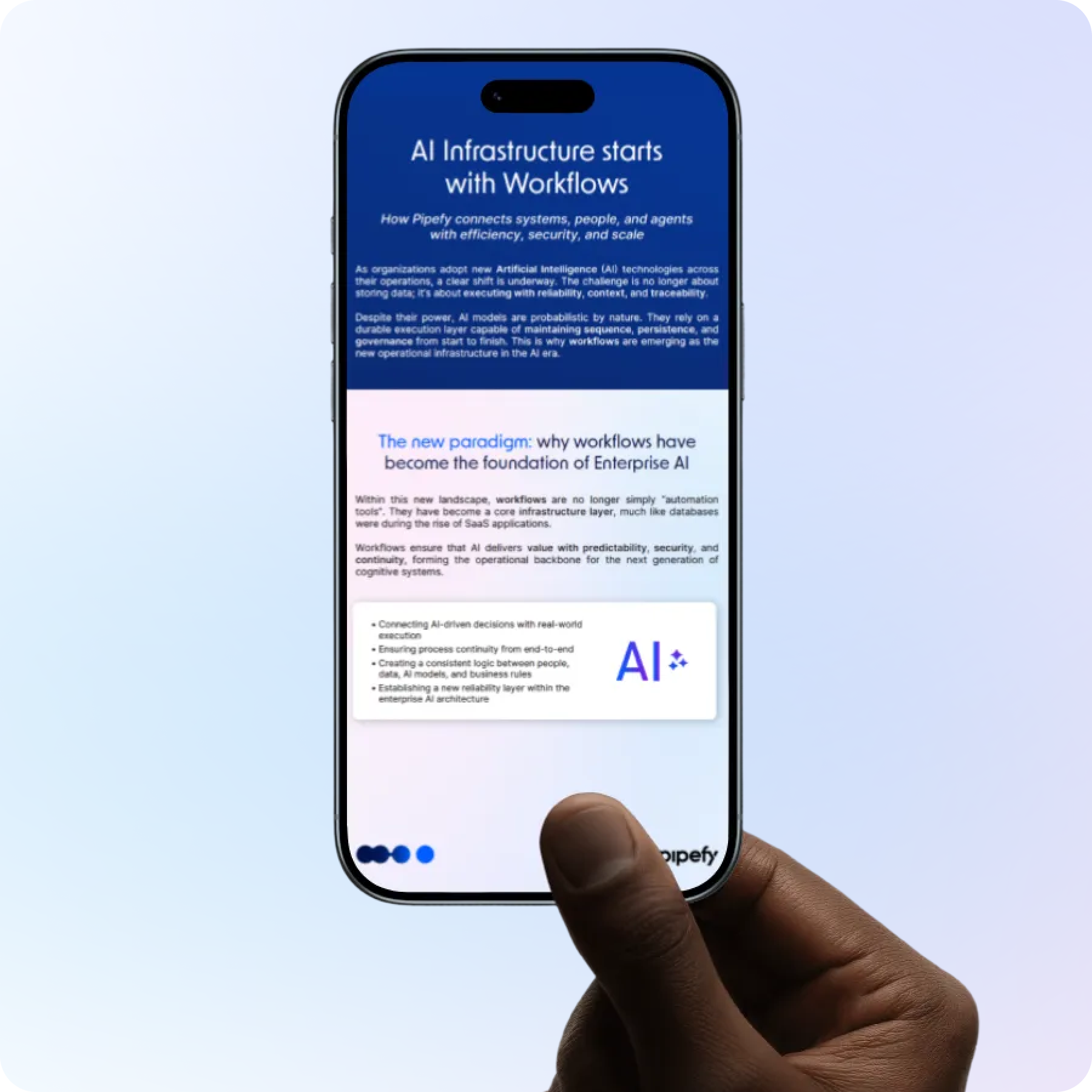
[One Pager] AI Infrastructure starts with Workflows: How Pipefy connects systems, people, and AI Agents with efficiency, security, and scale
What an enterprise automation platform needs to do for an IT-governed business
An enterprise automation platform is not just a place to build workflows. In a governed organization, it is the layer where the business moves fast and IT keeps control, at the same time. If it delivers one without the other, it has failed the assignment.
Concretely, that means three jobs at once. It has to let business teams build and run the automations they need without a ticket for every change. It has to give IT visibility and control over what those automations do, what data they touch, and which decisions they make. And it has to connect to the systems the enterprise already runs, rather than becoming one more island to reconcile.
That last point is the heart of it, and it is the principle we design around at Pipefy: the strongest platforms act as an orchestration layer on top of your existing stack, not a replacement for it. Don’t replace your systems, orchestrate on top of them. This is the same governance problem that shadow tools create from the bottom up, covered in depth in the guide to shadow IT and shadow AI governance, approached here from the top down: choosing the platform that keeps adoption and control in balance.
Why speed alone is the wrong criterion to evaluate an automation platform
Speed is table stakes. Nearly every modern platform can stand up a workflow quickly, so “fast to build” no longer separates the field. Worse, optimizing for speed alone actively works against a governed enterprise.
I have watched this mechanism play out. When a platform makes it trivial to automate but hard to govern, automations multiply faster than oversight can keep up. Each one moves data, calls a model, or makes a decision that no one is logging or reviewing.
The result looks a lot like sanctioned shadow AI: fast, useful, and invisible to the people accountable for risk. That is the same dynamic explored in the primer on what shadow AI is, now created by the tooling itself.
Many workflow orchestration tools are built exactly this way, powerful at execution, thin on governance. They earn their place in a proof of concept and then create exposure in production, when the pilot becomes a hundred live automations no one can fully account for.
The right criterion is not speed versus control. It is speed with control, which is the only version that survives at scale.

The governance checklist: audit trail, RBAC, model control, human oversight
This is where a serious evaluation lives. Score any enterprise automation platform, and any IT governance software you place around it, against a concrete checklist rather than a feature demo:
- Audit trail: every request, approval, and agent action logged and exportable, so you can prove a control was followed, not just claim it.
- Role-based access control (RBAC): permissions scoped by role, down to the field and the action, instead of all-or-nothing access.
- Model control: the freedom to choose your own model and keep company data out of training, so you are never locked into one vendor or exposed by default.
- Human oversight: human-in-the-loop review on the decisions that carry judgment or risk, while routine steps clear automatically.
- Integration without lock-in: open connectivity to the systems you already run, so governance never depends on ripping something out.
- Total cost of ownership: a no-code layer business teams operate themselves, weighed honestly against license, implementation, and consulting costs.
On the access side specifically, service accounts are what let IT grant scoped, revocable permissions to automations instead of leaning on personal credentials.
Side-by-side comparison: governance-first vs. automation-first approaches
The clearest way to use the checklist is to hold two philosophies next to each other. This is a comparison of approaches, not vendors: the difference is what the platform is designed to optimize for.
| Criterion | Automation-first approach | Governance-first approach |
| Audit trail | Partial or add-on logging | Complete, exportable record of every action and decision |
| Access control | Broad permissions, hard to scope | Role-based access down to the field and the action |
| AI and model control | Tied to one vendor’s model | Model-agnostic, with company data kept out of training |
| Human oversight | Optional or bolted on afterward | Human-in-the-loop built into the flow |
| Integration | Point connections, risk of lock-in | Orchestrates on top of the existing stack, no rip-and-replace |
| Optimizes for | Speed of building | Speed with control, at enterprise scale |
Read top to bottom, the automation-first column is how shadow AI ends up sanctioned by accident. The governance-first column is what keeps a fast operation auditable as it scales.
6 questions your IT team should ask before rollout
I turn that checklist into a short list of questions for any shortlist demo. Each one maps to a governance requirement, and the answers separate a genuine governance-first platform from a fast builder with a governance slide:
- Can we see and export a full audit trail of every automated action and AI decision?
- Can we scope access by role, and revoke it, without breaking the workflow?
- Can we bring our own model and keep sensitive data out of training?
- Where does a human stay in the loop, and who signs off on exceptions?
- Does it connect to the systems we already run, or does adoption mean replacing them?
- Who owns and maintains it day to day, the business or IT, and at what real cost?
If a platform cannot answer these cleanly, it is an automation tool with a governance story, not an enterprise automation platform built for a governed business.

How Pipefy governs automation at scale: a unified control plane, BYOLLM, and 600+ connectors
We built Pipefy for the governance-first column. Automation runs under a unified control plane that separates governance from execution, so every agent action is observable, auditable, and enforced against policy, while business teams keep the speed they want.
Human oversight is native
A Human-in-the-Loop Manager defines exactly when a person must review or approve, and role-based access scopes what each user and agent can see and do.
Controls backed by enterprise credentials
Those controls are backed by ISO 27001, ISO 27701, and ISO 42001 certifications, with SOC 1 and SOC 2 attestations.
Explicit model control
With bring your own LLM (BYOLLM), the platform stays model-agnostic and backed by a zero data retention posture: your data is never used to train AI, and the AI does not access sensitive data it has no reason to touch.
Integration without lock-in
On integration, Pipefy connects through native iPaaS and 600+ ready-to-use connectors, orchestrating on top of the stack you already run rather than replacing it, the focus of the guide on Pipefy’s Integration Hub.
That combination is why Pipefy was named one of the Market Shapers in Gartner’s Emerging Market Quadrant for No-Code Agent Builders — Startup Vendors, and why enterprises in over 100 countries run governed automation on it.
Success story: how Capgemini rebuilt HR service delivery at global scale
Capgemini is a clear example of governance at scale. The consulting firm consolidated 95 different HR request types into a single portal orchestrated by Pipefy, layered on top of its existing tools, including SharePoint single sign-on that reinforced security and governance, rather than replacing them.
On-time SLA compliance climbed to 98%, up from 38%, the triage team shrank from five people to 1.5, and the investment paid back in months.
My team is always looking for projects that pay for themselves. The work with Pipefy was one of those. We got our investment back in 3 to 5 months, just on the cost side.
Fabiano Carvalho
Director at Capgemini Brazil
Evaluate for governance, then move
My advice is straightforward: the platforms that win at enterprise scale are not the ones that automate fastest, they are the ones that let you automate fast and stay in control. Score your shortlist against the governance checklist, ask the hard questions before rollout, and favor the approach that orchestrates on top of what you already run.
For a deeper read on the category behind this approach, see the complementary guide on business orchestration and automation.
Now, to see why workflows, not another database, are becoming the foundation for governed enterprise AI, download our free one-pager, “AI Infrastructure starts with Workflows.”
Inside, you will find:
- Why workflows are the core infrastructure layer for enterprise AI, the way databases were for the SaaS era.
- How durable workflows turn AI pilots into governed production, with reliability and traceability built in.
- The business impact of pairing AI with structured automation, from faster execution to fewer errors and end-to-end visibility.
- Six real-world use cases, across Finance, HR, Customer Support, Sales, Onboarding, and Supply Chain.
- How Pipefy unifies no-code automation, AI Agents, and governance, with SSO, immutable logs, and model choice in one platform.
[One Pager] AI Infrastructure starts with Workflows: How Pipefy connects systems, people, and AI Agents with efficiency, security, and scale