Digital Assessment in 2026: Key Insights on Accessibility & Inclusion
Over the past year, digital assessment has been one of the most important conversations we’ve been part of.
Through conferences, webinars, podcasts, industry research and conversations with assessment providers, universities and specialists, we’ve had the opportunity to hear different perspectives on where assessments are heading and what challenges still remain.
While every conversation has been unique, several common themes have consistently emerged.
In this article, we’d like to share the ideas that have resonated most strongly with us, from sector-wide research and expert discussions to the practical experiences of organisations working to make digital assessment more accessible, inclusive and learner-centred.
We hope these insights contribute to the wider conversation about what the future of assessment could, and should, look like.
Three trends reshaping digital assessment
The conversations we’ve had across the assessment community all point in one direction: digital assessment is evolving quickly. Institutions are rethinking long-established practices, new technologies are changing how assessment is designed, and learner expectations continue to grow.
One report that captures many of these shifts comes from Jisc, whose latest research identifies three trends currently reshaping assessment in higher education. Rather than simply summarizing those findings, we’d like to look at what they mean through the lens of accessibility, inclusion, learner wellbeing, and Universal Design for Learning (UDL).
Because while assessment methods are changing, one question remains the same:
How do we design assessments that are fair, robust, and genuinely work for every learner?
1. Assessment is becoming more holistic
Jisc highlights a clear shift away from isolated, module-based assessments towards programme-level assessment. Instead of measuring knowledge through a collection of disconnected exams, institutions are increasingly designing assessments that evaluate learning across an entire programme, encouraging learners to demonstrate progression, reflection, and real-world application.
This change has the potential to reduce unnecessary assessment volume while creating a more meaningful learning journey.
What this means for accessibility and inclusion
A programme-level approach naturally creates opportunities to design accessibility into the assessment experience from the beginning.
Rather than focusing every accommodation on a single high-pressure exam, institutions can build multiple opportunities for learners to demonstrate their knowledge using different formats, different moments, and different forms of evidence.
By applying this flexible approach to assessments, institutions can reduce the stress from “the big exam”, creating a better experience for all learners while supporting wellbeing throughout the learning journey.
2. Generative AI is changing assessment, whether we’re ready or not
Generative AI has fundamentally changed the assessment landscape. The conversation is no longer about whether learners will use AI, but how institutions should respond.
Jisc identifies assessment redesign as one of the sector’s biggest priorities, with institutions exploring new formats that maintain academic integrity while continuing to measure genuine understanding, critical thinking, and applied knowledge.
Rather than resisting change, many institutions are beginning to redesign assessment around skills that AI cannot easily replicate.
What this means for accessibility and inclusion
The discussion around AI should not focus exclusively on preventing misuse. It should also ask whether assessment itself is evolving in ways that remain accessible, inclusive, and learner-centered.
Integrity and accessibility are not competing priorities. In fact, they depend on one another.
If assessment is to remain credible in an AI-enabled world, learners must have access to environments that are both secure and equitable, allowing them to demonstrate their knowledge without unnecessary barriers.
This is a topic we’ve explored in greater depth together with our partner SMOWL, looking at why academic integrity and accessibility must evolve together to preserve both learner trust and the long-term value of qualifications.
3. Learners are becoming partners in assessment design
Perhaps the most encouraging trend identified by Jisc is the growing desire to involve learners directly in assessment design.
For many years, accessibility discussions have focused primarily on accommodations, identifying learners with additional needs and providing individual support where necessary.
While accommodations remain essential, they were never designed to be the entire accessibility strategy.
Increasingly, institutions are recognizing that the learner experience itself should become part of assessment design.
Listening to learners helps identify unnecessary barriers, reduce anxiety, improve confidence, and ultimately create assessments that measure knowledge rather than a learner’s ability to navigate the assessment process itself.
What this means for accessibility and learner wellbeing
This is where we see the greatest opportunity for the future of assessment.
Instead of asking:
“How do we accommodate individual learners once barriers appear?”
Institutions are beginning to ask:
“How do we design assessments where fewer barriers exist in the first place?”
That shift reflects the principles of Universal Design for Learning.
When accessibility is embedded from the outset, everyone benefits:
- Learners gain greater independence and confidence.
- Institutions reduce the administrative burden associated with reactive accommodations.
- Assessment providers maintain fairness, validity, and security without sacrificing the learner experience.
Most importantly, wellbeing becomes part of assessment design, not something addressed afterwards.
We’ve explored this relationship between accessibility, learner wellbeing, and assessment in more detail in our article on why supporting learner wellbeing should be considered a core part of modern assessment design.
Industry research tells one part of the story. Conversations with practitioners tell another.
As part of our collaboration with Cirrus Assessment, we joined the Prove It podcast to discuss one question that sits at the centre of today’s accessibility conversation:
Are we measuring knowledge, or are we still measuring learners’ ability to overcome unnecessary barriers?
These three short clips capture the ideas that generated the most discussion.
Around 60% of neurodivergent learners never disclose their needs
One of the most striking statistics discussed during the conversation is that many neurodivergent learners choose not to disclose their condition.
If accessibility depends entirely on disclosure, fairness will always remain incomplete.
Equal accommodations don’t always create equal opportunities
Extra time remains one of the most common accommodations in assessment. But is it always the right one?
Sometimes the biggest barrier isn’t time itself. It’s unnecessary cognitive load, interface anxiety, or assessment design that unintentionally disadvantages certain learners.
Universal Design benefits everyone
One of our favorite moments from the discussion uses the “curb cut effect” to explain why accessibility should move beyond accommodations.
When environments are designed to remove barriers from the beginning, everyone benefits, not only those who requested support.
Assessment should work the same way.
Want to learn more?
If you’d like to see how Cirrus Assessment and ReadSpeaker work together to create more accessible and inclusive digital assessments, you can do it here.
If you’d like to watch the full conversation, you can listen to the complete Prove It Podcast here.
What practitioners are already putting into practice
During this year’s e-Assessment Association Conference, we joined fellow members of the Accessibility Special Interest Group (SIG) to explore one of the most important questions facing digital assessment today:
How can integrity strengthen, rather than limit, fairness and inclusion?
As Jarno Aantjes, Director of Education Sales EMEA & LATAM at ReadSpeaker, explains:
“Over the past year, many experts from the assessment industry all expressed the same concern: how to guarantee test security and result validity while safeguarding accessibility? Increasingly, organisations recognise that the historic solution of providing accommodations is suboptimal, as it requires disclosure by candidates and a large investment in distributing accommodations whilst safeguarding security and validity. This balancing act is causing headaches across the industry, and there is a clear move in the industry towards the Universal Design for Learning approach to prevent inaccessibility in advance instead of fixing through accommodations afterwards.”
The discussion brought together different perspectives from across the assessment sector, but several themes consistently emerged:

1. Accessibility is becoming an expectation, not just a compliance requirement
Accessibility legislation continues to expand across the world, from the European Accessibility Act (EAA) to national accessibility regulations in many countries.
But the conversation has moved well beyond legal compliance.
Increasingly, assessment providers and educational institutions recognize that accessibility is becoming a marker of assessment quality.
At the same time, learner expectations are changing.
Today’s learners expect digital experiences that are intuitive, flexible, and inclusive. Assessment should be no exception.
Improving accessibility is no longer only about meeting legal obligations. It is about creating assessment experiences that learners trust and feel confident using.
2. The accommodations model is no longer enough
Traditional accommodations remain an essential part of assessment. However, relying primarily on reactive accommodations presents growing challenges for both institutions and learners.
Institutions face increasing administrative complexity, rising accommodation requests, and the difficulty of delivering consistent support at scale.
Learners, meanwhile, often need to disclose personal information, navigate complex support processes, and wait until barriers have already appeared before receiving help.
As learner expectations continue to evolve, assessment design needs to evolve with them.
Rather than reacting to accessibility challenges after they emerge, assessment providers have an opportunity to build inclusive experiences from the beginning.
3. Universal Design for Learning offers a more sustainable future
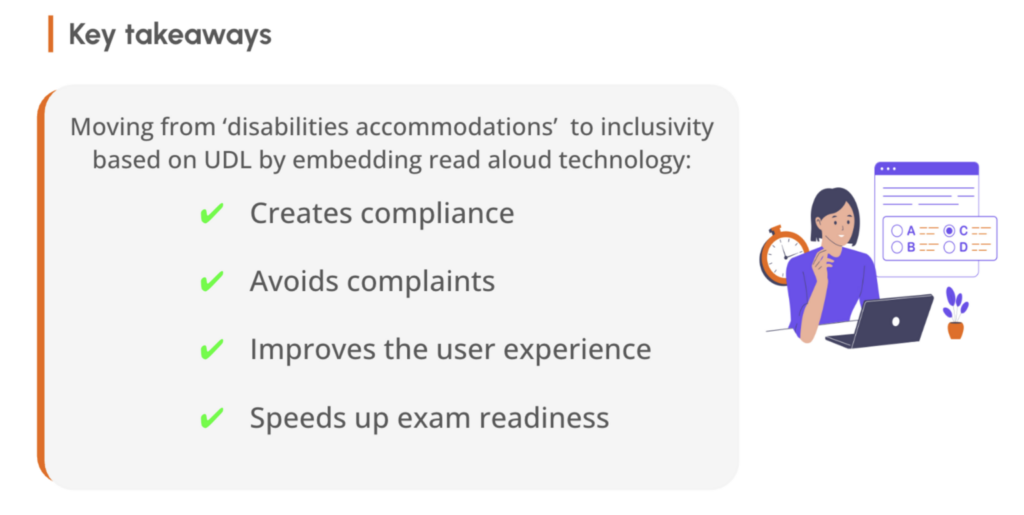
This is where Universal Design for Learning provides perhaps the clearest direction for the future of assessment. Rather than designing assessments for the “average” learner and adding accommodations later, UDL encourages institutions to design flexibility from the outset.
That benefits everyone involved (and takes us back to the curb-cut effect concept)
- Learners experience lower cognitive load, greater independence, improved confidence, and a stronger sense of fairness.
- Institutions reduce the operational costs associated with managing large numbers of individual accommodations.
- Assessment providers maintain the validity, integrity, and security of assessments while delivering a more consistent experience across diverse learner populations.
Ultimately, the goal is not to eliminate accommodations. It is to create assessment environments where fewer accommodations are needed because accessibility has already been considered during the design process. This would reduce the number of accommodations needed, the costs associated, and it would also improve the learner experience.
“Especially in the digital assessment space, we have seen many interesting changes by organisations like Cirrus, Televic Education, ANS, Inspera and Optimum Assessment to incorporate accessibility through Universal Design from the drawing board. While each does so from a different perspective, their is a common outcome: improved assessment experiences without any differences in availability of options between candidates. No more candidate complaints, no more accessibility incompliancy, no more technical hoops to jump that might impact security or validity.”
Jarno Aantjes, Director of Education Sales EMEA & LATAM at ReadSpeaker
Rethinking Digital Assessment: An Industry Perspective from Irene Custodio, Pearson’s Digital Assessment Design Lead

As Digital Assessment Design Lead at Pearson, you’ve had a front-row seat to the evolution of digital assessment. Looking back over the past few years, what do you think has been the most significant shift in how assessments are designed and delivered?
The most significant shift has been a move from simply translating paper assessments into onscreen assessments, towards recognising digital assessment as a design context in its own right. In the early stages of digital delivery, the focus was often on comparability, operational feasibility and whether the digital version could replicate the paper experience closely enough. Those questions still matter, but they are no longer sufficient. The more important question now is whether the assessment experience enables learners to show what they know, understand and can do, without introducing unnecessary barriers through the format, interface, language, layout or interaction model.
This increasing focus on fair and inclusive assessment by design means treating validity, accessibility and usability as interdependent, not separate, considerations. It also means considering inclusion across the whole assessment lifecycle, from construct definition and item design to delivery, scoring, reporting and evaluation. A technically accessible assessment is not automatically a valid one. Equally, a valid construct can still be undermined if learners experience avoidable barriers that prevent them from engaging with the task as intended. Digital assessment makes that relationship more visible. It gives us the opportunity to design more flexibly, but it also requires much sharper thinking about what is integral to the construct and what is simply inherited practice.
The most exciting development is that we can now bring together evidence from learner interactions, feedback, learner voice and process data to test our assumptions about assessment design. We can move beyond asking whether a task works in principle and focus instead on how different learners experience it in practice. That evidence base needs to be deliberately inclusive, drawing on a diverse range of learners and access needs, rather than assuming that the experience of the most visible or easiest-to-reach learners is representative. That is a powerful shift for inclusion, because it allows us to identify construct-irrelevant barriers that may previously have been invisible and to iterate designs in ways that strengthen, rather than dilute, validity.
From your perspective, what do you see as the biggest challenge facing organisations that design and deliver digital assessments today?
One of the biggest challenges is that organisations are trying to innovate within assessment systems that were largely built around paper-based assumptions. Digital assessment is often discussed as a delivery transformation, or worse, as an efficiency exercise, but the deeper challenge is a design transformation. If we keep the same item structures, the same visual conventions and the same assumptions about how learners navigate information, we risk carrying forward barriers that the digital mode has the potential to reduce.
This is particularly important for inclusion and accessibility. The sector needs to move beyond a compliance mindset where accessibility is checked at the end, or addressed primarily through accommodations, towards a model where learner diversity is part of the design brief from the beginning. That does not mean making assessments easier or compromising standards. It means being precise about what we intend to measure and removing barriers that measure something else, such as visual endurance, decoding load, navigation confidence, familiarity with a particular interaction, or the physical demands of the format.
This matters because more learners are already using technology to support learning and assessment, from laptops and computers through to assistive technologies such as screen readers, text-to-speech, speech-to-text, magnification and alternative input methods. However, those tools are often being used within assessment models that were not originally designed for digital delivery. That creates a gap between how learners access learning day to day and how they are expected to demonstrate their knowledge in high-stakes settings. Digital assessment should help close that gap, not simply make existing delivery processes faster.
The challenge is also cultural and operational. Good digital assessment design requires assessment specialists, accessibility experts, technologists, psychometricians, researchers, teachers and learners to work together. No single perspective is enough. I have seen the value of this first-hand through working in a multidisciplinary digital assessment design team, where different forms of expertise help surface risks, test assumptions and make better design decisions than any one discipline could make alone. The sector is increasingly rich in standards, frameworks and guidance, but the hard work is translating those principles into practical, evidence-led decisions, whilst ensuring validity and improving the experience for a much wider range of learners.
You’re also an active member of the e-Assessment Association’s Accessibility Special Interest Group. What motivates you to be involved in that community, and why do you think conversations like these are important for the future of digital assessment?
I am motivated by the fact that accessibility in assessment is both a technical issue and a fairness issue. It sits at the point where assessment validity, learner experience, policy, technology and ethical responsibility meet. Communities such as these are important because they create space for people across the sector to share what they are learning, challenge assumptions and move the conversation beyond minimum compliance.
Those conversations matter because no organisation solves these challenges alone. As digital assessment develops at pace, the sector needs a shared professional language for fairness, accessibility and validity in a digital context. That language should be supported by common frameworks, principles and codes of conduct, helping organisations make consistent, ethical and evidence-led decisions as practice evolves. We also need a more nuanced public conversation about technology. It is important to separate legitimate concerns about excessive or harmful uses of digital tools, such as some forms of social media, gaming or passive device use, from the highly beneficial ways in which digital technology and assistive technology can support access, independence, engagement and attainment for different learners. Without that nuance, the sector risks allowing a general negative narrative about screen use to obscure the real potential of well-designed digital assessment.
The value of the community is that it brings together different expertise and lived perspectives, helping the sector make better decisions than any one organisation could make in isolation. It also keeps learner voice in the conversation. If we are serious about inclusive digital assessment, then learners with diverse access needs must be represented in the evidence we collect and the decisions we make, not consulted as an afterthought once the model has already been designed.

Through the conferences, webinars and industry conversations we’ve been part of over the past year, one theme has consistently emerged: learner experience is becoming an increasingly important part of assessment design. Do you see the same shift across the sector, and what impact do you think it will have on the future of digital assessment?
Yes, I do see that shift, and I think it is one of the most important developments in the sector. Learner experience is sometimes misunderstood as a matter of preference or satisfaction, but in assessment it is much more fundamental than that. It is also something we need to understand through learner voice, not only through professional judgement. If a learner cannot navigate the task, locate the relevant information, use the tools available to them, or sustain attention because of avoidable design decisions, then the assessment may be measuring barriers in the assessment environment rather than the intended construct.
This is where digital assessment offers something genuinely powerful. Process data can help us understand not just whether learners arrive at an answer, but how they interact with the assessment on the way there. Patterns of navigation, time on task, tool use, changes in response, scrolling, pauses and interactions with resources can provide insight into where different learners may be experiencing friction, confusion or unnecessary cognitive load. Used carefully, ethically and alongside learner feedback, this kind of evidence can help assessment designers identify barriers that may not be obvious from scores alone.
The impact on the future of digital assessment could be significant. It allows us to test design decisions in a more granular way, with inclusion and validity considered together. Rather than designing from our own perspective or that of an imagined, average learner, we can build a richer evidence base about how different learners experience assessment content and platforms. But that evidence base needs to be intentionally diverse, including learners who use assistive technology, learners with SEND, learners with different language, literacy, sensory, cognitive and physical access needs, and learners whose experiences may not be captured through standard performance data alone. That should lead to more thoughtful assessment design, better targeted accessibility features and fewer avoidable barriers, while maintaining the integrity of what is being assessed.
There is also an opportunity to explore what it means to involve students in co-design processes in assessment design. That does not mean handing over decisions about standards or constructs, but it does mean creating structured ways for learners to contribute to design thinking, usability testing, accessibility reviews and post-assessment evaluation. For example, learners could help identify where instructions are unclear, where navigation creates unnecessary load, how accessibility features work in practice, or where an assessment feels misaligned with the way they use technology to learn. This should also be reciprocal in that students should be able to see that their input leads to better-designed assessments and, where appropriate, more transparent, usable and supportive assessment experiences. Teachers are also critical partners, because they understand how learners use technology in practice, what supports learning day to day, and where assessment can feel disconnected from classroom approaches. Done well, this kind of intentional collaboration can strengthen the evidence base and help make better, more grounded design decisions.
Many organisations are beginning to ask not “How do we provide more accommodations?” but “How do we design assessments that require fewer accommodations in the first place?” You’ve previously reflected on the importance of evolving assessment practice to better reflect how learners already use digital and assistive technologies. Do you see approaches such as Universal Design for Learning (UDL) helping to drive that shift? What opportunities, and perhaps challenges, do you think this creates?
I think Universal Design for Learning and inclusive design approaches are useful principles for informing good assessment design, but they need to be interpreted and applied carefully in context. They sit alongside the legal and regulatory requirements we need to meet and the user evidence base we should be gathering. Used well, they can support fairer assessment design by helping us consider accessibility, usability and validity together. They should not be understood as a one-size-fits-all solution, but as a way of creating a more inclusive baseline for a much wider range of learners, while still allowing for more focused, tailored support where it is needed. The ambition should be to design assessments that anticipate learner needs from the outset, rather than relying on individual accommodations to compensate for avoidable barriers introduced by the assessment design itself. That is especially important in digital contexts, where flexibility in presentation, navigation and interaction can be built into the standard experience.
The opportunity is to reduce stigma, increase learner agency and create assessment experiences that better reflect how many learners already use technology and assistive tools in their learning. This requires us to think about accessibility in the broader context of usability: how clearly information is laid out, how intuitive the platform is to navigate, how learners interact with content and questions, and how easily they can use built-in tools or assistive technologies such as text-to-speech and display adjustments. This can be critical for some learners and beneficial for all. When designed well, they do not change what is being assessed; they help ensure learners can access the assessment construct more fairly.
In reality, there will often still be one standard version of an assessment and the challenge is to design that experience with inclusivity in mind from the outset. This aligns with the needs-based principle already embedded in approaches such as JCQ access arrangements, where support is linked to evidence of need and a learner’s normal way of working, rather than to a diagnostic label alone. By recognising that many learners have common needs, we can design a standard assessment experience that works better for a wider range of students. Barriers to focus, processing speed, language, sensory experience, executive function, reading fluency and written expression are often reflected in the most commonly requested access arrangements and are also frequently identified among neurodivergent learners. Alternative formats, personalised arrangements and specialist support will still be needed for some learners. The aim is not to remove these adjustments, but to place them within a wider inclusive model: one in which the standard assessment is designed to be as accessible as possible, and any additional adjustments are purposeful, justified and preserve construct validity.
In a recent reflection, you posed an interesting question: are we sometimes too focused on protecting existing assessment practices rather than reimagining them to better meet the needs of today’s learners? What’s your perspective on that, and where do you think the balance lies between preserving assessment integrity and embracing innovation?
I do think we sometimes mistake familiarity for integrity. Existing assessment practices have developed for good reasons, and they protect important things, such as standards, reliability and public confidence. But not every inherited feature of assessment is essential to validity. Some practices are simply artefacts of paper delivery, operational constraint or historical convention. Digital assessment gives us an opportunity to ask more precisely what must be preserved because it is central to the construct, and what can be redesigned because it is an avoidable barrier. It may also allow us, where the evidence supports it, to think again about how constructs are defined, particularly where process data and observable learner behaviours provide richer evidence of reasoning, strategy, problem-solving or application than a final response alone.
The balance lies in being construct-led rather than format or task-led. Assessment integrity is not protected by keeping everything the same; it is protected by ensuring the assessment measures what it claims to measure, consistently and fairly. Innovation should therefore be evidence-led, carefully evaluated and transparent about its impact on validity, accessibility, usability and comparability. That means being clear about when digital design improves access, authenticity or the evidence we have about learner attainment, and when it risks adding novelty without assessment value. The question should not be whether digital assessment departs from tradition, but whether it enables a more valid and inclusive demonstration of what learners know and can do.
That distinction is important because digital assessment should not be framed primarily as a route to efficiency. Efficiency may be a benefit in some contexts, but it is not the purpose. The stronger case is that digital assessment can help us design more inclusive, evidence-led and valid ways for learners to demonstrate their knowledge, skills and understanding. To do that well, we need to resist simplistic narratives about technology, whether overly optimistic or overly negative, and focus instead on the quality of the design, the evidence behind it and the extent to which it supports fair access to the construct.
Bonus question. When you imagine the ideal digital assessment experience five years from now, what does it look like for learners?
In five years’ time, the ideal digital assessment experience would feel purposeful, flexible and fair. While no single standard assessment experience will meet every learner’s needs, it should be designed with a much wider range of learners in mind, rather than an assumed ‘average’ learner. The interface should help learners focus on the knowledge, skills and understanding being assessed, rather than on unnecessary barriers created by layout, navigation or interaction design.
Greater accessibility and usability would be built into the standard assessment environment, carefully bounded by validity. Learners would also have flexibility to adjust the interface to meet specific access needs, use appropriate assistive technologies and, where appropriate, benefit from adaptive assessment models that are transparent, carefully validated and responsive to learner needs or performance while maintaining construct integrity. The experience would also feel more aligned with how learners already use technology in learning.
It would also be evidence-led and continually improving. Process data, learner feedback, learner voice and performance evidence would be used together to understand how different learners experience tasks, tools and platforms, and to inform better design before and after assessments go live. As AI becomes part of everyday learning, assessment may need to place more emphasis on reasoning, process and application, not only final products. It will also be important to recognise that AI already underpins some assistive technologies, and that newer AI tools may support access for some learners. Governance will need to distinguish legitimate access needs from wider concerns about AI use, so that learners are not unfairly prevented from using tools that support access to the construct. Emerging technologies could support insight and personalisation, but only where their use is proportionate, explainable and protects fairness, validity and learner trust.
So, what comes next?
If there is one thing we’ve learned from spending the past year immersed in the digital assessment ecosystem, it is that the conversation is moving quickly.
From generative AI and academic integrity to accessibility, learner wellbeing, Universal Design for Learning and learner experience, assessment is being reconsidered from multiple angles. But underneath many of these discussions is a bigger shift: digital assessment is moving beyond the question of how to deliver existing assessments and towards a deeper question of how assessments should be designed in the first place.
One of the clearest themes we’ve encountered is the move away from asking, “How do we accommodate more learners?” and towards asking, “How do we design assessments that create fewer barriers in the first place?”
That does not mean removing accommodations or creating one assessment experience that works identically for everyone. It means building a more inclusive baseline, informed by learner voice, evidence and good design, while preserving the flexibility to provide additional support where it is genuinely needed.
It also means recognising that accessibility, learner experience, wellbeing, validity and integrity are not separate conversations. They are increasingly interconnected parts of the same assessment challenge.
For us, the future is about making digital assessments more accessible, more inclusive and better able to let every learner demonstrate what they know and can do.
If you’re exploring how technology can support that journey, we’d be happy to show you how text-to-speech can help create more flexible assessment experiences and give learners greater choice in how they access assessment content.