AI Data Extraction Software for Accounts Payable Teams: How Enterprise AP Automation Reduces Costs, Errors, and Processing Time
AI Data Extraction Software for Accounts Payable Teams
Accounts payable departments are under pressure from every direction. Invoice volumes keep climbing, suppliers expect faster payments, finance leaders want tighter cash flow visibility, and compliance requirements are getting more complex every year.
Yet many AP teams still rely on manual invoice processing, fragmented email approvals, spreadsheet tracking, and legacy OCR systems that struggle with real-world document variability.
That gap is exactly why AI data extraction software has become one of the fastest-growing investments in enterprise finance operations.
Modern AI-powered invoice processing platforms do much more than scan PDFs. They identify vendors, extract line items, validate purchase orders, detect anomalies, route approvals, sync with ERP systems, and continuously improve extraction accuracy through machine learning.
For enterprise finance managers, the shift is no longer about “digitizing invoices.” It’s about building a scalable financial operations infrastructure that reduces processing costs while improving control, auditability, and payment velocity.
The difference between traditional OCR and enterprise document AI is massive — especially at scale.
What AI Data Extraction Software Actually Does
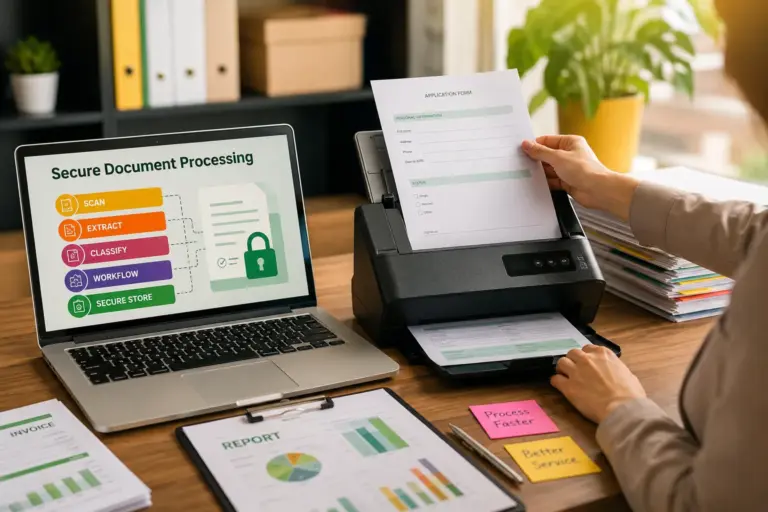
At its core, AI data extraction software converts unstructured financial documents into structured, usable business data.
In accounts payable environments, this typically includes:
- Supplier invoices
- Purchase orders
- Receipts
- Credit memos
- Delivery notes
- Vendor contracts
- Tax documents
- Payment confirmations
Instead of requiring staff to manually key information into ERP systems, AI models automatically identify and extract:
- Invoice numbers
- Vendor names
- Tax IDs
- Payment terms
- Due dates
- PO references
- Line-item details
- Currency fields
- Totals and subtotals
- VAT or sales tax amounts
The extracted data then flows into downstream finance workflow automation systems for validation, approvals, coding, and payment execution.
For enterprise accounting teams processing thousands of invoices monthly, this dramatically reduces repetitive manual work.
Why Traditional OCR Fails Modern Finance Teams
A lot of organizations already experimented with OCR years ago. Many abandoned it because the results were inconsistent.
Traditional OCR systems operate primarily on character recognition. They can read text, but they struggle to understand document context.
That creates major problems in AP environments where invoices vary widely between vendors.
For example:
- One supplier places invoice totals at the top right
- Another puts them at the bottom
- Some invoices contain tables
- Others include handwritten notes
- Multi-language invoices complicate extraction
- Scanned PDFs often contain poor image quality
Legacy OCR tools frequently break when layouts change.
Finance teams then spend hours correcting extraction errors manually — which defeats the purpose of automation.
Modern intelligent OCR platforms use machine learning, natural language processing, and computer vision to understand document structure semantically rather than relying solely on fixed templates.
That distinction changes everything.
How Intelligent OCR Platforms Work in Enterprise AP
An intelligent OCR platform combines several AI technologies into a unified extraction pipeline.
Document Classification
Before extraction begins, the system identifies document type automatically.
It determines whether the file is:
- An invoice
- Purchase order
- Credit note
- Shipping document
- Contract
- Expense receipt
Classification accuracy matters because downstream extraction logic depends on document context.
Computer Vision Processing
Enterprise document AI systems analyze layout structure visually.
Instead of merely reading text, the platform identifies:
- Tables
- Headers
- Totals
- Signature zones
- Payment sections
- Vendor blocks
- Tax areas
This allows the system to process highly variable invoice formats.
Natural Language Understanding
Modern invoice data capture platforms also interpret semantic meaning.
For instance, the system understands that:
- “Invoice No.”
- “Invoice ID”
- “Billing Reference”
- “Inv #”
may all refer to the same field.
That flexibility significantly improves extraction accuracy.
Machine Learning Feedback Loops
The best AP automation tools continuously learn from corrections.
If finance staff adjusts extracted values, the system retrains models over time to improve future performance.
This is especially valuable in enterprise environments with recurring vendors.
Core Features Enterprise Finance Teams Should Prioritize
Not all AI data extraction software platforms are designed for enterprise-grade AP operations.
Finance leaders evaluating solutions should focus on several high-impact capabilities.
High-Accuracy Invoice Data Capture
Accuracy is foundational.
Even small extraction errors can create payment delays, duplicate payments, or reconciliation problems.
Enterprise-grade platforms often achieve extraction accuracy above 90–95% under real operational conditions.
But accuracy claims should always be validated using real invoice samples.
ERP Integration
The software must integrate cleanly with systems such as:
- SAP
- Oracle NetSuite
- Microsoft Dynamics 365
- Workday
- Sage Intacct
- Infor
- Coupa
Weak integrations create workflow fragmentation.
Strong ERP synchronization enables true end-to-end finance workflow automation.
Multi-Channel Invoice Intake
Invoices arrive from everywhere:
- Vendor portals
- Scanners
- EDI systems
- Mobile uploads
- Shared drives
Modern enterprise document AI platforms centralize intake automatically.
Approval Workflow Automation
Data extraction alone is not enough.
Enterprise AP workflows require:
- Approval routing
- Threshold rules
- Escalations
- Exception handling
- Delegation controls
- Audit logs
The strongest AP automation tools integrate extraction with workflow orchestration.
Fraud Detection and Validation
Advanced AI systems can identify anomalies such as:
- Duplicate invoices
- Suspicious vendor changes
- Mismatched PO amounts
- Unusual payment terms
- Altered invoice totals
This capability is becoming increasingly important as invoice fraud grows more sophisticated.
Invoice Data Capture: From PDF Chaos to Structured Financial Data
Invoice data capture is often where finance transformation initiatives either succeed or fail.
A typical enterprise AP department receives invoices in wildly inconsistent formats.
Some vendors send:
- Native PDFs
- Scanned paper invoices
- Image attachments
- Excel files
- EDI feeds
- Multi-page documents
Human operators can adapt instantly to these differences. Traditional automation systems cannot.
AI-powered invoice data capture platforms solve this by learning patterns across document structures.
For example, enterprise document AI can:
- Separate header fields from line items
- Detect tax breakdowns automatically
- Normalize date formats
- Interpret multiple currencies
- Match invoices against purchase orders
- Extract embedded metadata
This turns unusable document chaos into structured accounting records.
The operational impact is substantial.
Instead of spending several minutes processing each invoice manually, AP teams can reduce touch time dramatically.
Some organizations achieve straight-through processing rates exceeding 70–80% for standard invoices.
Enterprise Document AI and Multi-Format Processing
One major advantage of enterprise document AI is adaptability.
Finance teams rarely operate in standardized environments.
Global enterprises may process invoices across:
- Multiple countries
- Different tax systems
- Various languages
- Regional compliance frameworks
- Diverse vendor ecosystems
AI extraction systems trained on broad document sets can adapt to this variability far better than rule-based systems.
Multi-Language Support
International AP operations often require support for:
- English
- German
- French
- Spanish
- Japanese
- Arabic
- Chinese
Advanced intelligent OCR platforms can extract financial fields across multilingual invoice structures.
Line-Item Extraction
Many AP systems struggle with line-item parsing.
Yet detailed line-item extraction is critical for:
- Spend analytics
- Procurement validation
- Inventory reconciliation
- Cost center allocation
- Tax compliance
Enterprise AI extraction systems use table recognition models to process complex invoice grids accurately.
Handling Poor-Quality Documents
Real-world invoices are messy.
Finance teams routinely receive:
- Skewed scans
- Low-resolution images
- Fax artifacts
- Cropped files
- Shadowed pages
Computer vision models help normalize and enhance document readability automatically.
Finance Workflow Automation Beyond Data Entry
A common misconception is that AI data extraction software only automates typing.
In reality, the biggest operational gains come from workflow orchestration.
Modern finance workflow automation platforms connect extraction directly to downstream AP operations.
Three-Way Matching
The system can automatically compare:
- Invoice
- Purchase order
- Goods receipt
When values align within tolerance thresholds, invoices can move directly toward payment approval.
Exception Handling
Not every invoice processes cleanly.
Advanced AP automation tools intelligently route exceptions to appropriate personnel based on:
- Department
- Vendor
- Invoice amount
- Business unit
- Region
- Approval matrix
This reduces bottlenecks dramatically.
Real-Time Visibility
Finance leaders gain dashboards showing:
- Invoice aging
- Approval delays
- Processing bottlenecks
- Cash flow exposure
- Exception volumes
- Vendor payment status
This operational visibility is often impossible in manual AP environments.
AI Data Extraction vs Manual AP Processing
The operational differences become obvious quickly.
| Area | Manual AP | AI-Powered AP |
|---|---|---|
| Invoice Entry | Human typing | Automated extraction |
| Processing Speed | Slow | Near real-time |
| Error Rate | Higher | Lower |
| Scalability | Labor-dependent | Software-scalable |
| Auditability | Fragmented | Centralized |
| Fraud Detection | Reactive | Proactive |
| Reporting | Limited | Real-time |
| Cost Per Invoice | High | Reduced over time |
Manual processing also creates hidden operational costs:
- Staff burnout
- Vendor disputes
- Payment delays
- Lost early-payment discounts
- Compliance risk
- Reconciliation overhead
AI-driven AP automation addresses these inefficiencies systematically.
AI-Powered AP Automation Use Cases Across Industries
Different industries use enterprise document AI differently.
Manufacturing
Manufacturers often process:
- High invoice volumes
- Complex procurement chains
- Multi-line invoices
- Global suppliers
AI extraction helps accelerate supplier payment cycles while improving procurement visibility.
Healthcare
Healthcare finance teams deal with:
- Regulatory complexity
- Vendor compliance
- High document sensitivity
- Insurance-related invoices
Automation improves processing consistency and audit readiness.
Retail
Retailers manage massive supplier ecosystems.
Invoice automation supports:
- Seasonal scaling
- Inventory reconciliation
- Distributed operations
- Faster payment processing
Logistics and Transportation
Freight invoices are notoriously inconsistent.
AI extraction platforms help normalize:
- Fuel charges
- Shipment references
- Carrier fees
- Customs documentation
ERP Integration and Enterprise Finance Infrastructure
AP automation projects fail surprisingly often because of weak ERP integration planning.
Enterprise finance environments depend heavily on interconnected systems.
The AI extraction layer must integrate cleanly with:
- ERP systems
- Procurement software
- Vendor management platforms
- Treasury systems
- Compliance software
- Data warehouses
API-Based Connectivity
Modern AI data extraction software typically uses APIs to synchronize:
- Invoice status
- Vendor records
- Payment data
- Approval states
- General ledger coding
Master Data Validation
Enterprise AP automation systems should validate invoices against:
- Vendor master data
- PO records
- Tax registries
- Banking details
This reduces downstream reconciliation problems.
Cloud vs On-Premise Deployment
Large enterprises may require:
- Private cloud deployments
- Hybrid infrastructure
- Regional data residency
- On-premise processing
Deployment flexibility matters heavily in regulated industries.
Compliance, Audit Trails, and Security Considerations
Finance automation introduces major governance considerations.
Enterprise AP systems process sensitive financial information daily.
That includes:
- Banking details
- Tax identifiers
- Vendor contracts
- Payment records
- Financial approvals
Auditability
Modern AP automation tools maintain comprehensive audit trails showing:
- Who approved invoices
- When changes occurred
- What fields were modified
- Which exceptions were triggered
This improves internal controls substantially.
Regulatory Compliance
Finance teams must comply with frameworks such as:
- SOX
- GDPR
- HIPAA
- PCI DSS
- Regional tax regulations
AI extraction platforms should support compliance reporting and retention policies.
Role-Based Access Controls
Enterprise systems should support granular permissions for:
- AP clerks
- Controllers
- Auditors
- Procurement teams
- Regional finance managers
Reducing Fraud and Invoice Manipulation Risks
Invoice fraud is becoming more sophisticated.
Attackers increasingly exploit:
- Vendor impersonation
- Fake invoices
- Banking detail manipulation
- Email compromise schemes
AI-powered systems help reduce exposure by identifying suspicious patterns automatically.
Duplicate Invoice Detection
The software can flag:
- Matching invoice numbers
- Similar amounts
- Repeated vendors
- Duplicate line items
Behavioral Analysis
Advanced enterprise document AI systems analyze patterns such as:
- Unusual payment timing
- Abnormal vendor behavior
- New banking information
- Suspicious invoice formatting
Approval Policy Enforcement
Automation ensures approval policies are enforced consistently across departments.
That reduces human oversight gaps significantly.
Measuring ROI from AP Automation Tools
Finance executives rarely approve automation investments without measurable ROI.
Fortunately, AP automation often delivers clear operational savings.
Lower Processing Costs
Manual invoice processing can cost anywhere from several dollars to significantly more per invoice depending on complexity.
Automation reduces:
- Data entry labor
- Correction time
- Paper handling
- Exception management
Faster Invoice Cycles
Quicker approvals improve:
- Supplier relationships
- Early payment discount capture
- Cash flow forecasting
Reduced Error Rates
Fewer errors mean:
- Less rework
- Fewer disputes
- Cleaner reconciliations
- Improved audit outcomes
Better Staff Utilization
Instead of repetitive data entry, AP teams can focus on:
- Vendor management
- Strategic finance operations
- Spend analysis
- Exception resolution
That shift improves both productivity and employee retention.
Common Implementation Mistakes Finance Teams Make
Even strong software implementations can fail operationally.
Several issues appear repeatedly.
Ignoring Process Standardization
Automation magnifies process inefficiencies.
If approval workflows are chaotic before implementation, software alone will not solve the problem.
Underestimating Exception Handling
No AI system achieves 100% automation.
Teams must design intelligent exception workflows carefully.
Poor Vendor Onboarding
Supplier participation matters.
Invoice standardization initiatives often improve automation accuracy significantly.
Weak Change Management
Employees may resist workflow automation if communication is poor.
Training and phased rollout strategies help reduce friction.
Choosing Based Only on OCR Accuracy
Extraction accuracy matters, but workflow functionality, ERP integration, scalability, and governance are equally important.
How to Evaluate AI Data Extraction Software Vendors
Enterprise buyers should evaluate vendors strategically rather than focusing solely on demos.
Ask About Real Accuracy Rates
Marketing claims can be misleading.
Request testing using your own invoice samples.
Evaluate Industry Specialization
Some vendors perform better in:
- Manufacturing
- Healthcare
- Logistics
- Retail
- Financial services
Industry-specific document training matters.
Review Integration Ecosystems
Check for prebuilt connectors with your finance stack.
Integration complexity can dramatically affect implementation timelines.
Analyze AI Training Models
Key questions include:
- Does the system learn continuously?
- How are corrections handled?
- Can models adapt regionally?
- How is vendor variability managed?
Investigate Security Architecture
Enterprise finance software must meet strict security standards.
Review:
- Encryption methods
- Access controls
- Compliance certifications
- Data residency policies
The Future of Accounts Payable Automation
AP automation is moving beyond extraction into autonomous finance operations.
Several trends are accelerating.
Generative AI in Finance Workflows
Large language models are beginning to support:
- Invoice explanation summaries
- Natural language queries
- Automated dispute handling
- Supplier communication assistance
Predictive Finance Operations
AI systems increasingly forecast:
- Payment delays
- Cash flow issues
- Fraud risk
- Supplier behavior
Autonomous Invoice Processing
The long-term goal is touchless AP.
In mature environments, AI systems may eventually handle:
- Intake
- Validation
- Matching
- Routing
- Approval recommendations
- Payment scheduling
with minimal human intervention.
Deeper Procurement Integration
AP automation is becoming tightly linked with procurement analytics and spend intelligence platforms.
That convergence improves enterprise financial visibility significantly.
FAQ
What is AI data extraction software?
AI data extraction software uses artificial intelligence, machine learning, OCR, and document understanding technologies to convert unstructured business documents into structured digital data automatically.
How does intelligent OCR differ from traditional OCR?
Traditional OCR mainly recognizes characters. Intelligent OCR platforms understand document structure, context, semantics, and relationships between fields, which improves extraction accuracy significantly.
Can AI invoice data capture handle scanned PDFs?
Yes. Modern enterprise document AI systems can process scanned invoices, image files, low-quality PDFs, and multi-format financial documents.
What ERP systems integrate with AP automation tools?
Most enterprise AP automation platforms integrate with ERP systems like SAP, Oracle NetSuite, Microsoft Dynamics 365, Workday, Coupa, and Sage Intacct.
Is AI-powered AP automation secure?
Enterprise-grade solutions typically include encryption, audit logs, role-based access controls, compliance support, and fraud detection mechanisms.
What is straight-through invoice processing?
Straight-through processing refers to invoices being processed automatically without manual intervention because extraction, validation, and approval conditions are met successfully.
How long does AP automation implementation take?
Implementation timelines vary depending on integration complexity, invoice volume, workflow customization, and organizational readiness. Enterprise deployments often take several weeks to several months.
Can enterprise document AI extract invoice line items?
Yes. Advanced AI extraction systems use table recognition and computer vision models to capture detailed line-item data from invoices.
What are the biggest AP automation ROI drivers?
The largest ROI contributors usually include reduced labor costs, faster approvals, lower error rates, fewer duplicate payments, and improved cash flow visibility.
Does AI data extraction software improve compliance?
Yes. Automated audit trails, policy enforcement, document retention, and approval tracking often strengthen compliance controls substantially.
Conclusion
Accounts payable automation has evolved far beyond simple OCR scanning.
Today’s AI data extraction software acts as a core operational layer inside modern finance organizations. It transforms fragmented invoice workflows into structured, intelligent, scalable financial processes.
For enterprise finance managers, the opportunity is no longer just operational efficiency. It’s strategic financial infrastructure.
The strongest platforms combine intelligent OCR, enterprise document AI, workflow orchestration, ERP integration, fraud detection, and analytics into a unified AP ecosystem.
Organizations that modernize AP operations now are positioning themselves for faster close cycles, better vendor relationships, improved compliance, stronger financial visibility, and lower operational costs over the long term.
As invoice complexity grows and finance teams face increasing pressure to do more with fewer resources, AI-powered accounts payable automation is quickly becoming foundational enterprise infrastructure rather than optional optimization.