HIPAA Compliant OCR Software: How Secure Healthcare OCR Transforms Medical Records Automation
HIPAA Compliant OCR Software
Healthcare organizations still run on documents. Patient intake forms, insurance claims, lab reports, referral letters, discharge summaries, consent forms, prior authorizations, and billing records move through hospitals every hour. Even in highly digitized environments, paper and scanned PDFs remain deeply embedded in clinical and administrative workflows.
That creates a serious operational problem.
Manual data entry slows down staff, increases administrative costs, introduces human error, and creates compliance exposure. At the same time, healthcare providers face growing pressure to modernize workflows while staying aligned with HIPAA privacy and security requirements.
This is where HIPAA compliant OCR software becomes strategically important.
Modern OCR platforms do far more than convert scanned text into editable documents. Advanced healthcare OCR systems now combine artificial intelligence, natural language processing, document classification, encrypted document processing, and workflow automation to securely extract medical data at scale.
For healthcare IT managers and compliance leaders, the conversation is no longer just about digitization. It’s about operational resilience, audit readiness, data governance, and secure AI healthcare workflows.
The organizations implementing secure healthcare OCR effectively are reducing administrative overhead, accelerating claims processing, improving patient onboarding, and building more scalable compliance operations.
Why OCR Matters in Modern Healthcare
Healthcare generates massive volumes of unstructured data.
A single patient journey can involve:
- Physician notes
- Handwritten prescriptions
- Insurance documentation
- Diagnostic imaging reports
- Referral packets
- Lab results
- Consent forms
- EOBs and billing statements
- Legacy medical archives
Many hospitals still rely on hybrid systems where electronic health records coexist with paper-heavy operational processes.
That fragmentation creates bottlenecks.
Administrative teams often spend hours manually entering patient information into EHR systems. Compliance departments struggle with document retention and audit traceability. Revenue cycle teams lose time processing claims and prior authorizations manually.
OCR technology changes this dynamic by extracting usable data from:
- Scanned paper records
- Faxed healthcare documents
- PDFs
- Images
- Handwritten forms
- Legacy archives
But in healthcare, standard OCR platforms are not enough.
Protected Health Information (PHI) introduces security and compliance obligations that require specialized safeguards.
Understanding HIPAA Requirements for OCR Systems
The Health Insurance Portability and Accountability Act (HIPAA) establishes strict requirements for handling protected patient data.
Any OCR platform used in healthcare must align with HIPAA’s Privacy Rule, Security Rule, and Breach Notification Rule.
This means OCR systems handling PHI must support:
- Access controls
- Encryption
- Audit logging
- User authentication
- Data integrity protection
- Secure transmission
- Role-based permissions
- Business Associate Agreements (BAAs)
Healthcare organizations sometimes make a dangerous assumption: if a cloud provider claims “secure OCR,” it must automatically be HIPAA compliant.
That’s not necessarily true.
Many general-purpose OCR APIs lack:
- Signed BAAs
- Healthcare-specific access controls
- PHI isolation controls
- Compliance reporting
- Long-term audit retention
- Regional data residency guarantees
HIPAA compliance is not a marketing checkbox. It’s an operational framework.
A secure healthcare OCR deployment requires both technical safeguards and organizational governance.
What Makes OCR Software HIPAA Compliant?
Not all OCR engines are designed for healthcare environments.
A HIPAA compliant OCR platform typically includes several critical components.
End-to-End Encryption
Healthcare OCR systems should encrypt data:
- In transit
- At rest
- During backup storage
- During document transmission
Encrypted document processing reduces exposure during file transfers and cloud synchronization.
Strong encryption standards commonly include:
- AES-256
- TLS 1.2 or higher
- Secure VPN transport
- Key management controls
Business Associate Agreement (BAA)
Any OCR vendor handling PHI must be willing to sign a Business Associate Agreement.
Without a BAA, healthcare organizations may expose themselves to compliance liability.
This is one of the first procurement checkpoints compliance teams should evaluate.
Audit Trails and Logging
Healthcare compliance teams need visibility into:
- Who accessed records
- When documents were processed
- What changes occurred
- Which users exported data
- Failed access attempts
- Administrative actions
Detailed audit logging supports:
- Internal investigations
- HIPAA audits
- Incident response
- Security monitoring
Role-Based Access Controls
Not every employee should have access to all patient records.
Advanced OCR platforms support:
- Granular user permissions
- Department-level access segmentation
- Identity provider integrations
- Single sign-on (SSO)
- Multi-factor authentication
Secure Data Retention Policies
OCR workflows frequently create temporary files, caches, extracted text layers, and indexed archives.
Healthcare organizations need strict retention controls to avoid unnecessary PHI exposure.
Core Security Features Healthcare Organizations Should Demand
Healthcare OCR deployments operate inside highly regulated environments. Security architecture matters just as much as OCR accuracy.
Zero-Trust Access Architecture
Modern healthcare cybersecurity strategies increasingly adopt zero-trust principles.
That means:
- Continuous authentication
- Least-privilege access
- Network segmentation
- Session monitoring
- Identity verification
OCR platforms integrated into clinical systems should align with those security models.
Immutable Audit Records
Tamper-resistant logging helps organizations maintain defensible compliance documentation.
This becomes especially important during:
- Security incidents
- OCR processing disputes
- Regulatory investigations
- Legal discovery
Secure API Integrations
OCR systems increasingly connect with:
- EHR platforms
- Revenue cycle systems
- Patient portals
- Document management systems
- AI analytics engines
Poorly secured APIs create attack surfaces.
Healthcare IT teams should evaluate:
- API authentication methods
- OAuth support
- Encryption standards
- API rate limiting
- Logging visibility
Data Residency and Sovereignty
Some healthcare organizations must maintain regional control over patient data.
OCR vendors should clearly explain:
- Data hosting locations
- Replication policies
- Backup geography
- Cross-border processing practices
OCR Use Cases in Hospitals and Healthcare Networks
Healthcare OCR adoption goes far beyond simple scanning.
The most effective implementations automate operational workflows across departments.
Patient Intake Automation
Manual intake processes create delays and errors.
OCR systems can extract information from:
- Insurance cards
- Driver’s licenses
- Referral forms
- Consent documents
- Patient history forms
This reduces front-desk workload while accelerating registration accuracy.
Medical Records Digitization
Hospitals still maintain massive legacy archives.
OCR technology helps convert:
- Historical charts
- Archived pathology reports
- Imaging documentation
- Old billing records
into searchable digital records.
Prior Authorization Processing
Prior authorizations remain one of healthcare’s most frustrating administrative burdens.
OCR automation helps extract:
- Procedure codes
- Insurance identifiers
- Physician information
- Supporting documentation
This reduces processing time and administrative fatigue.
Claims and Revenue Cycle Automation
Revenue cycle management teams rely heavily on document processing.
Healthcare OCR platforms support:
- Claims ingestion
- EOB extraction
- Invoice matching
- Remittance processing
- Coding workflows
The result is faster reimbursement cycles and fewer manual processing errors.
Clinical Documentation Workflows
Advanced AI healthcare workflows now combine OCR with intelligent document understanding.
Systems can classify:
- SOAP notes
- Lab reports
- Medication lists
- Referral summaries
- Radiology findings
This improves data accessibility across care teams.
AI-Powered Healthcare Workflows and Intelligent Document Processing
Traditional OCR extracts text.
Modern healthcare OCR platforms interpret documents contextually.
That distinction matters.
AI-powered document processing combines:
- Optical character recognition
- Machine learning
- Natural language processing
- Document classification
- Entity extraction
- Workflow automation
This enables far more sophisticated healthcare operations.
Intelligent Data Extraction
Instead of merely reading text, AI systems identify:
- Patient names
- ICD-10 codes
- CPT codes
- Dates of service
- Provider identifiers
- Medication names
- Insurance information
This significantly reduces manual review requirements.
Workflow Routing Automation
AI-driven healthcare compliance software can automatically route documents to:
- Billing teams
- Physicians
- HIM departments
- Prior authorization specialists
- Compliance reviewers
That reduces workflow friction across departments.
Clinical Decision Support
Some healthcare systems integrate OCR outputs into analytics platforms that support:
- Population health analysis
- Utilization management
- Risk stratification
- Predictive care models
Of course, these workflows require strong governance to avoid introducing AI-related compliance risks.
Comparing Traditional OCR vs AI-Driven Healthcare OCR
The gap between legacy OCR and modern intelligent document processing is substantial.
| Feature | Traditional OCR | AI Healthcare OCR |
|---|---|---|
| Basic text extraction | Yes | Yes |
| Handwriting recognition | Limited | Advanced |
| Document classification | Minimal | Automated |
| Context understanding | No | Yes |
| Workflow automation | Limited | Extensive |
| Clinical entity extraction | No | Yes |
| EHR integration support | Basic | Advanced |
| Compliance analytics | Minimal | Strong |
| Scalability | Moderate | High |
Traditional OCR still works for simple archival digitization.
But healthcare organizations pursuing operational transformation typically need AI-enabled systems capable of handling complex medical documentation.
Integration Challenges and Deployment Considerations
Healthcare environments are notoriously complex.
OCR deployments often intersect with legacy systems, fragmented databases, and strict governance policies.
EHR Compatibility
Healthcare IT managers must evaluate compatibility with:
- Epic
- Cerner
- MEDITECH
- athenahealth
- Allscripts
- NextGen Healthcare
Integration capabilities can dramatically impact implementation success.
Structured vs Unstructured Data
Healthcare documents vary widely.
Some contain clean forms with predictable layouts.
Others involve:
- Handwritten physician notes
- Fax artifacts
- Poor scan quality
- Mixed document types
AI-enhanced OCR engines perform significantly better under these conditions.
Scalability Planning
Large healthcare systems process millions of pages annually.
OCR infrastructure should support:
- High-volume ingestion
- Concurrent processing
- Workflow orchestration
- Redundancy
- Disaster recovery
Staff Training and Change Management
Technology alone does not solve operational inefficiencies.
Healthcare organizations must train staff on:
- Secure document handling
- Workflow changes
- Access control policies
- Exception management
- Compliance responsibilities
Cloud vs On-Premise HIPAA OCR Solutions
Healthcare organizations often debate deployment architecture.
Both cloud and on-premise OCR models have advantages.
Cloud-Based OCR
Benefits include:
- Faster deployment
- Lower infrastructure costs
- Easier scaling
- Continuous AI model updates
- Remote accessibility
However, compliance teams must carefully validate:
- BAA coverage
- Cloud security controls
- Tenant isolation
- Vendor risk management
On-Premise OCR
Some hospitals prefer local deployments for tighter control.
Advantages include:
- Internal infrastructure ownership
- Greater customization
- Data residency control
- Reduced external dependency
The downside is higher operational complexity and infrastructure maintenance.
Hybrid Healthcare OCR Models
Many healthcare enterprises now adopt hybrid architectures.
Sensitive workloads remain on-premise while scalable AI processing occurs in secure cloud environments.
This approach balances flexibility and governance.
Compliance Risks and Common Mistakes
OCR deployments can create compliance exposure when poorly implemented.
Several recurring mistakes appear across healthcare environments.
Using Consumer OCR Tools for PHI
Employees sometimes upload patient records into general-purpose OCR apps without realizing the compliance implications.
This creates major risk.
Unauthorized cloud processing may violate HIPAA requirements immediately.
Weak Access Controls
Broad employee access permissions increase insider risk exposure.
Least-privilege access remains essential.
Inadequate Vendor Assessments
Healthcare organizations should thoroughly evaluate:
- Security certifications
- SOC 2 reports
- Penetration testing
- Incident response policies
- Subprocessor relationships
Poor Document Retention Governance
Temporary OCR files can accidentally remain accessible for extended periods.
Retention automation and secure deletion policies matter.
Lack of Monitoring
Without centralized logging and monitoring, organizations may miss:
- Unauthorized exports
- Failed authentication attempts
- Suspicious activity
- Data leakage incidents
How OCR Supports Revenue Cycle and Operational Efficiency
OCR is often discussed as a compliance tool, but the operational impact can be just as significant.
Healthcare organizations face intense administrative cost pressure.
Secure medical records automation reduces friction across multiple workflows.
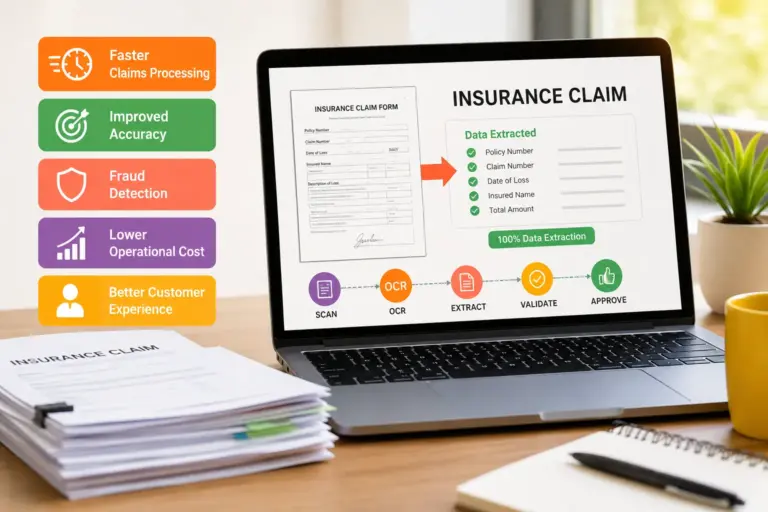
Faster Claims Processing
Automated extraction reduces delays in:
- Claims intake
- Coding validation
- EOB matching
- Remittance posting
This can improve cash flow predictability.
Reduced Manual Labor
Administrative staff spend less time on repetitive data entry.
That allows teams to focus on:
- Patient support
- Exception handling
- Complex reviews
- Revenue optimization
Improved Data Accuracy
Human data entry errors remain common in healthcare operations.
AI-assisted OCR systems improve consistency and reduce transcription mistakes.
Better Patient Experience
Faster intake and processing workflows reduce patient frustration.
That directly affects:
- Satisfaction scores
- Retention
- Operational efficiency
- Staff workload
Evaluating OCR Vendors for Healthcare Environments
Choosing the right healthcare compliance software requires more than reviewing OCR accuracy benchmarks.
Healthcare IT leaders should evaluate vendors across multiple dimensions.
Security and Compliance
Key questions include:
- Will the vendor sign a BAA?
- What encryption standards are supported?
- How is PHI isolated?
- What certifications exist?
- How are incidents handled?
AI Model Performance
Healthcare documents are complex.
Organizations should request testing using real-world document samples.
Accuracy varies dramatically depending on:
- Scan quality
- Handwriting
- Document variability
- Specialty terminology
Workflow Integration
OCR systems should integrate cleanly with:
- EHR platforms
- ECM systems
- Revenue cycle software
- Identity providers
- SIEM platforms
Scalability
Healthcare organizations grow.
OCR platforms should support future expansion without forcing infrastructure redesigns.
Vendor Transparency
Strong vendors openly discuss:
- Security architecture
- AI limitations
- Processing pipelines
- Data retention
- Subprocessors
Avoid vendors that provide vague compliance answers.
Cost Considerations and ROI Analysis
Healthcare OCR investments involve both direct and indirect ROI factors.
Direct Savings
Organizations often reduce costs associated with:
- Manual data entry
- Paper storage
- Document retrieval
- Claims delays
- Administrative overhead
Indirect Value
Long-term benefits may include:
- Faster patient onboarding
- Better audit readiness
- Reduced compliance exposure
- Improved staff productivity
- Enhanced operational scalability
Pricing Models
Healthcare OCR vendors commonly use:
- Per-page pricing
- Volume-based processing
- Subscription licensing
- Enterprise agreements
- API consumption billing
IT leaders should evaluate total cost of ownership rather than focusing solely on initial licensing.
Future Trends in Secure Healthcare OCR
Healthcare OCR is evolving rapidly.
Several emerging trends are reshaping the space.
Generative AI Integration
AI copilots increasingly assist with:
- Clinical summarization
- Intelligent indexing
- Workflow recommendations
- Document interpretation
Healthcare organizations will need strong governance frameworks as these capabilities mature.
Real-Time Document Intelligence
Future OCR systems will process documents instantly during:
- Patient intake
- Telehealth onboarding
- Claims submission
- Clinical workflows
Multimodal AI Processing
Modern healthcare AI systems are beginning to combine:
- Text extraction
- Image recognition
- Voice transcription
- Clinical NLP
This creates richer operational intelligence.
Privacy-Preserving AI
Techniques like:
- Federated learning
- Differential privacy
- Confidential computing
may become increasingly important for secure healthcare AI workflows.
FAQ
What is HIPAA compliant OCR software?
HIPAA compliant OCR software is an optical character recognition platform designed to securely process protected health information while meeting HIPAA privacy and security requirements. These systems typically include encryption, audit logging, access controls, and signed Business Associate Agreements.
Can standard OCR software be used for medical records?
Not safely in most cases. Many general-purpose OCR tools are not designed for regulated healthcare environments and may lack required compliance safeguards.
Is cloud OCR allowed under HIPAA?
Yes, cloud OCR can be HIPAA compliant if appropriate safeguards exist, including encryption, access controls, audit logging, and a signed Business Associate Agreement.
What types of healthcare documents can OCR process?
Healthcare OCR systems commonly process:
Patient intake forms
Insurance cards
Physician notes
Lab reports
Claims documents
Referral records
Consent forms
Billing documentation
Does AI improve healthcare OCR accuracy?
Yes. AI-powered OCR systems improve recognition for handwritten text, poor scan quality, document classification, and contextual medical data extraction.
What are the biggest risks in healthcare OCR deployments?
Common risks include:
Unauthorized cloud usage
Weak access controls
Poor vendor oversight
Inadequate retention policies
Unsecured API integrations
How does OCR support medical records automation?
OCR automates the extraction and routing of healthcare data, reducing manual entry and improving workflow efficiency across clinical and administrative operations.
Conclusion
Healthcare organizations are under pressure from every direction: rising administrative costs, stricter compliance expectations, cybersecurity threats, staffing shortages, and increasing demands for operational efficiency.
HIPAA compliant OCR software sits at the intersection of those challenges.
Done correctly, secure healthcare OCR is far more than a digitization tool. It becomes foundational infrastructure for medical records automation, intelligent document workflows, compliance operations, revenue cycle optimization, and scalable healthcare AI initiatives.
The difference between a basic OCR deployment and a truly healthcare-grade platform comes down to governance, security architecture, workflow integration, and operational maturity.
Healthcare IT leaders evaluating OCR solutions should prioritize long-term resilience over short-term convenience. Compliance, interoperability, auditability, and AI readiness now matter just as much as text recognition accuracy.
As healthcare workflows continue shifting toward intelligent automation, organizations with secure and scalable document processing infrastructure will be positioned to move faster, reduce administrative friction, and manage compliance with far greater confidence.