Pipefy’s Integration Hub: Orchestrate Your Systems
ARTICLE SUMMARY
Enterprise systems integration is the work of connecting the tools an organization already runs, from the ERP to legacy apps, into one governed, automated flow. Pipefy’s Integration Hub does this by orchestrating on top of your stack, so you modernize processes without a risky system-replacement project.
By Sobhan Daliry, Chief Product Officer (CPO) at Pipefy
Almost every CIO I talk to carries the same scar tissue: a system-replacement project that ran long, cost more than the business case promised, and disrupted the operation before it delivered any value. So when the goal is to modernize how work actually flows, the instinct to rip out the old system and start fresh deserves hard scrutiny.
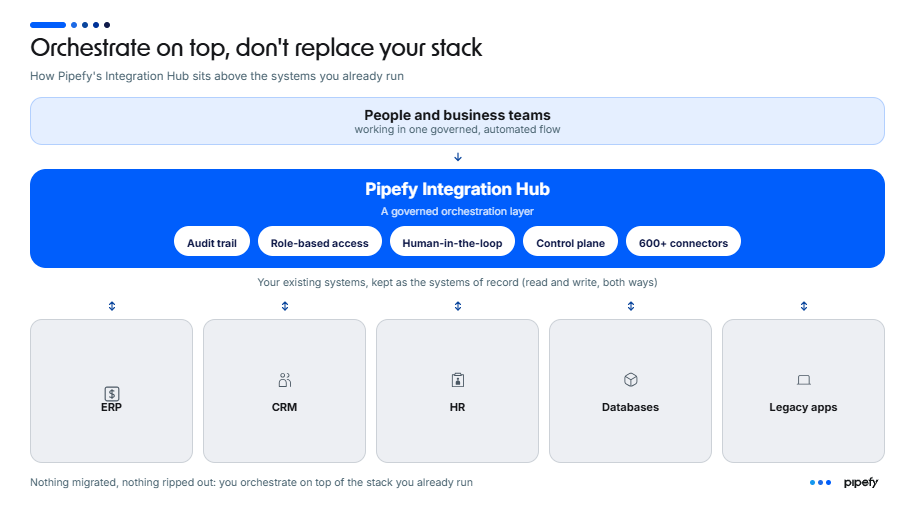
There is a faster, lower-risk path. Enterprise systems integration done well does not mean replacing your stack, it means orchestrating on top of it. You connect the systems you already run into governed, automated workflows, and you modernize the process without touching the systems of record underneath.
That is what we built Pipefy’s Integration Hub to do. In this article, I will walk through what changes when you orchestrate instead of replace, how the Integration Hub connects your enterprise systems and legacy tools, how governance and an audit trail hold across every connection, how quickly it goes live, and when it beats a custom build.
The principle behind all of it is simple: don’t replace your systems, orchestrate on top of them.
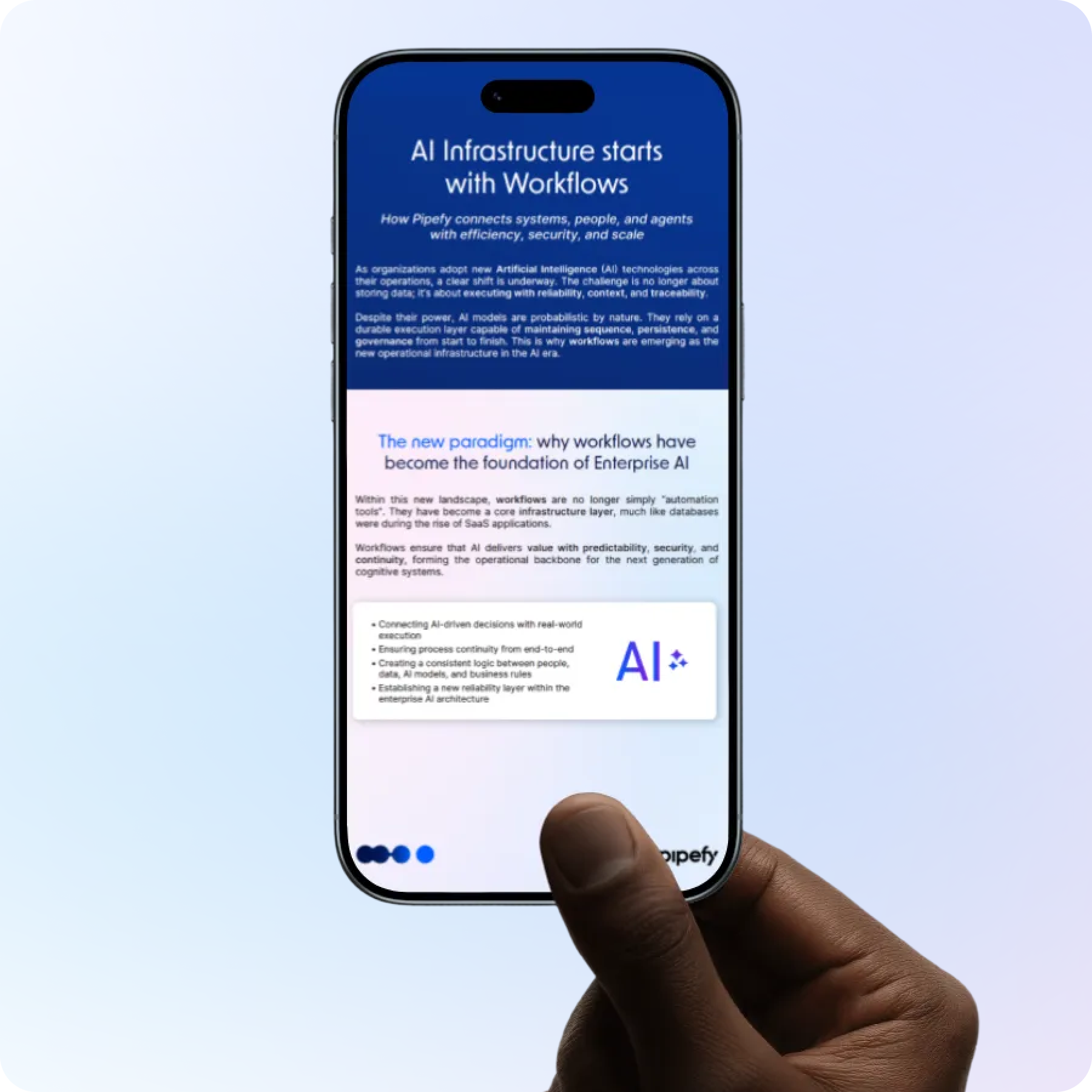
[One Pager] AI Infrastructure starts with Workflows: How Pipefy connects systems, people, and AI Agents with efficiency, security, and scale
What changes when you orchestrate instead of replace
The assumption behind most modernization projects is that a slow or messy process means the underlying system has to go. In my experience, that is rarely true. The system of record is usually fine at what it was built for. The pain lives in the layer around it: the intake, approvals, handoffs, and status-chasing that still run on email and spreadsheets between your core systems.
Replacing the system does nothing for that layer. It consumes budget and years, disrupts the operation, and leaves the same manual process running on a newer database.
The budget math makes this worse, not better: Deloitte’s 2026 Global Technology Leadership Study estimates that technical debt already consumes 21% to 40% of IT spending, and a full replacement tends to add to that load rather than lift it.
Orchestrating on top solves the actual problem. You add a governed workflow layer that coordinates the work across your existing tools, while each system keeps doing its job as the record of truth.
The payoff is speed without risk. Nothing is migrated, nothing is ripped out, and the business gets a modern, automated process in a fraction of the time.
This is the same governance challenge that shadow tools create from the bottom up, covered in the guide to shadow IT and shadow AI governance, solved here at the system layer: one orchestrated flow instead of a patchwork no one controls.
How Pipefy’s Integration Hub connects your enterprise systems and legacy tools
The Pipefy Integration Hub is the layer that makes this practical. It connects through native iPaaS capabilities and 600+ ready-to-use connectors, spanning ERPs, CRMs, HR systems, databases, and internal APIs, so a workflow in Pipefy can read from and write to the systems that own the data.
That reach is what makes Pipefy a real ERP integration platform rather than another point tool. The orchestration layer reads and writes the records the ERP owns, such as vendors, cost centers, and purchase orders, so the two stay in sync without duplicate entry, and the ERP remains the system of record.
When a system does not have a prebuilt connector, an HTTP action connects to virtually any API, a pattern the Pipefy Community documents in its explainer on how the HTTP action connects any API to your flow.
This matters most for the legacy tools that modern software usually refuses to talk to. Older, heavily customized systems are exactly where rip-and-replace projects get justified, and exactly where orchestration avoids them: instead of forcing the business off a system that works, the Integration Hub wraps a governed, automated flow around it.
Governance and audit trail across every connected system, with a unified control plane
For an enterprise buyer, integration is only half the question. The other half is whether all that connected activity stays governed. It does, because every workflow runs under a unified control plane that separates governance from execution: each action across each connected system is observable, auditable, and enforced against policy.
In practice, that means three things hold no matter how many systems you connect:
- Every request, approval, and automated action is logged in a complete, exportable audit trail.
- Access is scoped with role-based permissions and service accounts, so automations use governed, revocable credentials rather than someone’s personal login.
- A Human-in-the-Loop Manager keeps a person on the decisions that carry judgment, while routine steps clear automatically.
Data control is explicit too. With BYOLLM (Bring Your Own LLM), the platform stays model-agnostic under a zero data retention posture, so your data is never used to train AI. All of it is backed by ISO 27001, ISO 27701, and ISO 42001 certifications, with SOC 1 and SOC 2 attestations.
This is the same governed model that keeps ungoverned shadow AI from taking root, and it is part of why Pipefy was named one of the Market Shapers by Gartner in No-Code Agent Builders.
Implementation timeline: from kickoff to go-live in days, not months
The other objection to any new platform is time. Here the contrast with a replacement project is stark: because the Integration Hub sits on top of your stack rather than inside it, go-live is measured in days, not months.
The rollout is phased by design. One process or system goes live first while everything else keeps running as it is, so there is no big-bang cutover and no risk to the systems of record. Each additional system connects when it is ready, under the same governance, and the operation is never taken offline to get there.
Success story: how Samsonite orchestrated on top rather than replacing
Samsonite’s team kept its older, legacy ERP, the kind of system most modern tools cannot work with, and integrated Pipefy on top of it instead of forcing a migration.
Our ERP system is an older version of Oracle’s J.D. Edwards, and many workflow solutions simply don’t work with it. Pipefy is one of the few that is flexible and allows this integration.
Mauricio Rizzi
Procurement and Customer Service Manager | Samsonite
The result was 100% of requests managed in one place, more than 2,370 hours saved in five months, and a 177% return on investment, without touching the ERP.
Build vs. Buy: when Pipefy’s Integration Hub beats a custom integration
Enterprises with strong engineering teams often ask why not just build the integrations in-house. It is a fair question, and sometimes custom code is the right call. But for orchestrating processes across systems, a governed platform usually wins on total cost and risk.
My rule of thumb: build when the integration is your core product, buy when it is plumbing that has to be governed and maintained forever.
| Dimension | Custom-built integration | Pipefy Integration Hub |
| Time to first value | Months of development | Days, with ready-to-use connectors |
| Maintenance | Your team owns every fix and breakage | Connectors are maintained for you |
| Resilience | Breaks when a connected system or API changes | Adapts without a rebuild |
| Governance | Bolted on later, if at all | Audit trail, RBAC, and oversight built in |
| Key-person risk | Logic lives with whoever built it | No-code, owned by the team, not one engineer |
The hidden cost of building is not the first integration, it is the tenth, plus the years of maintenance as every connected system changes underneath it.
Weighing that trade-off is exactly what the guide on how to evaluate an enterprise automation platform for governance is built to help you do.

See it on your own stack
If you are weighing modernization against the risk of a system replacement, there is a third option, and it is the one I would choose every time: orchestrate on top of what you already run. Keep your systems of record, connect them into governed workflows, and modernize the process without the disruption.
The fastest way to judge it is on your own environment. Book a demo to see the Pipefy Integration Hub connect your systems.
To see why workflows, not another database, are becoming the foundation for governed enterprise AI, download our free one-pager, “AI Infrastructure starts with Workflows: How Pipefy connects systems, people, and AI Agents with efficiency, security, and scale.”
Inside, you will find:
- Why workflows are the core infrastructure layer for enterprise AI, the way databases were for the SaaS era.
- How durable workflows turn AI pilots into governed production, with reliability and traceability built in.
- The business impact of pairing AI with structured automation, from faster execution to fewer errors and end-to-end visibility.
- Six real-world use cases, across Finance, HR, Customer Support, Sales, Onboarding, and Supply Chain.
- How Pipefy unifies no-code automation, AI Agents, and governance, with SSO, immutable logs, and model choice in one platform.
[One Pager] AI Infrastructure starts with Workflows: How Pipefy connects systems, people, and AI Agents with efficiency, security, and scale