Risks, Detection, and Best Practices – n8n Blog
Traditional security monitoring was built for deterministic systems. AI workloads break that assumption — outputs vary between runs, prompts carry hidden instructions, and model behavior drifts each time the weights are retrained.
Modern teams need AI security monitoring. This works on two fronts: using AI to detect threats across infrastructure, and watching AI systems for exploitation. Great platforms manage both, providing proactive resolution and observability.
In this guide, explore AI security monitoring, including the risks, detection mechanics, and practices that hold up in production.
AI security risks and vulnerabilities
Threats to AI systems target the model itself or the data feeding it, which means traditional cybersecurity tooling — designed for endpoints, networks, and applications — misses the signal until the model fails.
There are several risks to be aware of.
Data poisoning
Attackers tamper with training data to embed flaws or biases that surface later in production. Once a poisoned dataset trains a model, the corruption persists through downstream deployments, and teams may not detect it for weeks.
In production, this leads to classification errors that cluster around specific inputs, or outputs that violate policies under narrow triggers. The monitoring signal sits in two places: dataset integrity checks at ingestion (hash mismatches, distribution shifts, unauthorized writes to training stores) and behavioral drift in deployed AI models against a known-good baseline.
Adversarial attacks
Adversarial inputs make a model produce wrong outputs, like a few pixels altered on an image or a few tokens added to a prompt. Unlike traditional cyberattacks, the input itself looks innocuous. The attack becomes visible only when the model produces incorrect output.
Production teams see these as anomaly clusters in inference logs: identical-looking requests producing widely different confidence scores or repeated near-duplicate inputs probing the same decision boundary. Catching these early means setting up behavioral baselines on inference telemetry before a fraud-detection model starts approving wire transfers it should have blocked.
Prompt injection
OWASP lists prompt injections at the top of its LLM threat list. They’re hard to patch because they exploit architecture rather than bugs: language models can’t reliably distinguish between instructions and data. An attacker hides a directive inside text the model processes — like a document, email, or URL — and the model follows it.
Direct injections come through the user input field. Indirect injections sit in external content the model fetches mid-task, which is easy to miss. One way of mitigating this risk is to treat any external LLM inputs as potentially unsafe. Wrap these inputs inside explicit XML tags (i.e.
Supply chain vulnerabilities
Most AI systems pull pretrained models, open-source libraries, and third-party datasets from public registries. Each becomes part of the attack surface. For instance, a tampered dependency in a popular ML library or an outdated container image could ship malicious code into your inference path on the next deployment.
Continuous monitoring of model provenance, dependency hashes, and registry signatures catches drift before it spreads. Ensure you have SBOM coverage for ML artifacts to have a paper trail if something goes wrong.
How AI security monitoring works
Rule-based SIEM (Security Information and Event Management) looks for known patterns. AI security monitoring looks for unknown ones. Most attacks against AI systems carry no signature. The detection layer has to work from learned behavior, not predefined rules.
The visual observability stack collects three categories of telemetry: inference inputs and outputs with their confidence scores, runtime metrics covering both model performance (latency, throughput) and data pipeline health (ingestion volume, schema drift), and access patterns showing who calls the API and from where. Each category routes into a centralized detection layer where a structured log emitter feeds an anomaly detection service, then alerts are enriched with threat intel and CMDB (Configuration Management Database) context and forwarded to the SIEM.
Anomaly detection runs on unsupervised machine learning rather than rules. The system builds a behavioral baseline for each model in production and flags deviation. For example, a sudden spike in outputs hitting content filters, a drop in average confidence, or a new clustering pattern in user inputs. Prompt injection classifiers filter at the input stage, and pipeline monitors catch poisoning at the data ingestion layer before training resumes.
Traditional SIEM platforms, like Splunk, Elastic, and Microsoft Sentinel, collect logs and events from infrastructure and correlate them using predefined rules. That approach catches credential abuse and known malware signatures, but it fails for adversarial inputs that don’t trip rules, or for model drift that only surfaces as a slow change in output distribution. AI-native monitoring sits on top of the SIEM, instead of next to it. The SIEM still handles infrastructure-layer events, while the AI monitoring layer feeds it model-level anomalies the SIEM wasn’t designed to catch.
Best practices for AI security monitoring with n8n
The practices below are vendor-neutral, but they all share an operational problem: the AI stack (model serving, vector stores, training pipelines) and the security stack (SIEM, ticketing, on-call) rarely speak the same language. n8n acts as the orchestration layer — routing model-level signals into the workflows your security team already runs, without forcing a parallel monitoring stack.
Validate and monitor your training data pipelines
Data poisoning is cheap to execute and expensive to detect after the fact, which is why teams need to validate data at ingestion. Hash every dataset version and compare distributions against a known-good baseline, and flag schema changes the moment they hit the pipeline.
n8n’s HTTP Request node and webhook triggers wire those checks into a single workflow. A hash mismatch fires an alert into PagerDuty and pauses the downstream training run until a human signs off — no custom Python glue to maintain across the pipeline.
Establish behavioral baselines for every model in production
Production AI model security starts with the assumption that the model itself will change. Drift happens for reasons unrelated to attackers: input distributions shift, retraining alters response patterns, and downstream consumers change how they call the API.
The way to tell drift from an attack is a baseline built from confidence distributions and output length histograms. n8n evaluations make this concrete: define a golden dataset, re-run it against the production model on a schedule, and score the output against expected behavior. Scheduled triggers run the evaluation at whatever interval the SLO demands (every 15 minutes is typical), and anomaly alerts route to wherever your team already operates, i.e. Splunk.
Integrate AI telemetry with your existing SIEM
A parallel monitoring stack duplicates infrastructure your security team runs — alert routing, on-call rotations, and the audit trail are already in place. The goal isn’t to replace infrastructure but extend it with AI-layer signals it can correlate against everything else.
For teams operating under strict data residency or network egress policies, n8n’s self-hosted deployment keeps alert telemetry inside the organization’s own infrastructure. For regulated industries, on-prem telemetry is a hard requirement, SaaS-native SOAR tools force data to transit external endpoints, locking out these industries.
Automate incident response with condition-based playbooks
Detection that doesn’t trigger a response just generates audit logs that sit in a folder. The playbook layer translates an alert into action, like revoking a credential, rotating an API key, or quarantining a model endpoint.
Hard-coding that logic into Python scripts works until the playbook needs to change, at which point you’re shipping code through a release process. n8n’s visual workflow builder lets security engineers build conditional response logic across cybersecurity integrations without that overhead. Webhook triggers fire from the SIEM, condition nodes route based on severity and asset class while keeping secrets in the managed credential store, and HTTP Request nodes hit remediation APIs. If you want a working starting point, the CVE monitoring template wires OpenAI processing into ServiceNow incidents in under 10 minutes.
Monitor and maintain AI with n8n
Prompt injection and sensitive data leakage happen at inference time. The defense is a filtering layer that inspects every unsafe input before it reaches the model and every output before it reaches the user or a downstream tool.
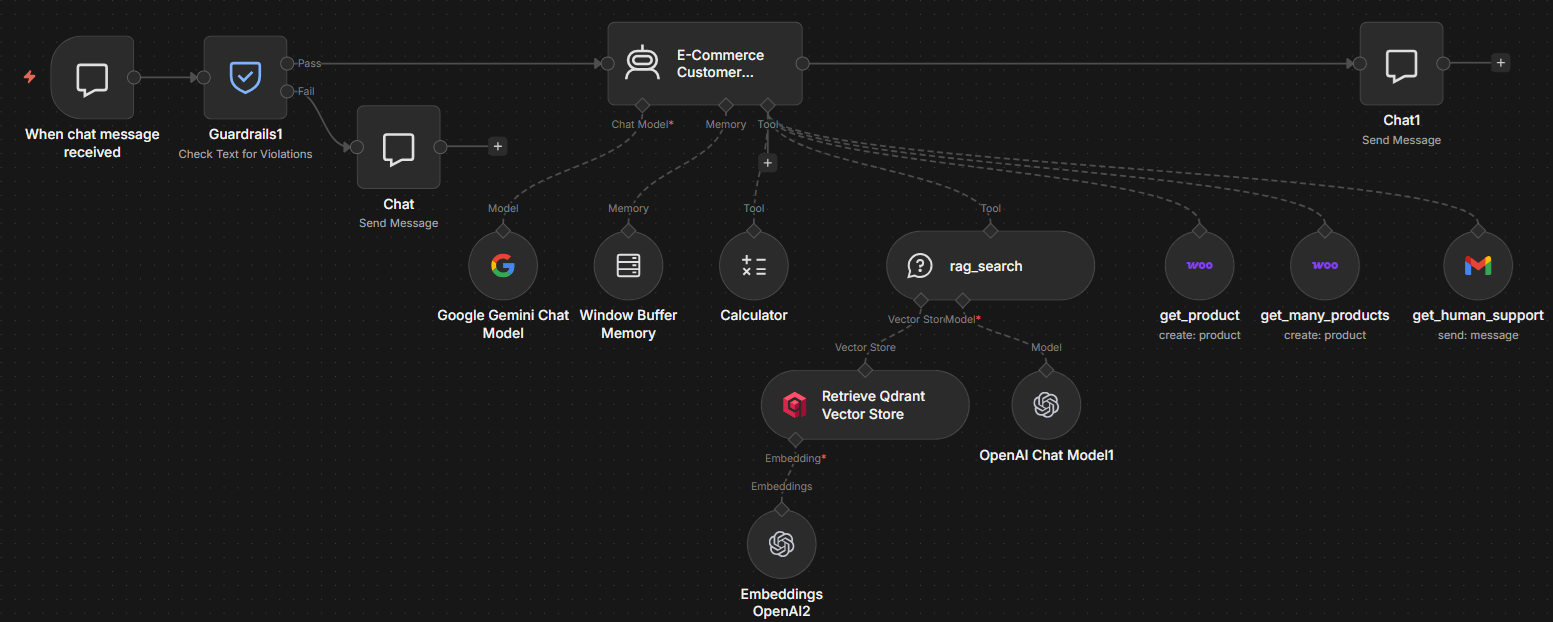
n8n’s guardrails node runs that check inside the workflow itself. Inputs get screened for injection patterns and policy violations; outputs get checked for leaked PII, credentials, or instructions that shouldn’t surface. Failed checks route to a separate branch instead of the main response path, so the security team gets the event in the usual alerting channel as everything else.
FAQ
What’s the difference between AI security and AI cybersecurity?
AI security covers protecting AI systems — models, training pipelines, inference endpoints — from malicious manipulation. AI cybersecurity refers to using AI to defend traditional IT infrastructure, like anomaly detection in network traffic and automated phishing classification. The first asks how to keep the model safe. The second asks how AI makes the security stack better.
How can prompt injection be prevented?
Prevent prompt injection at the structural level. Separate the system prompt from user input at the application layer, validate input against expected schemas before it reaches the model, and apply content filtering on outputs that could carry exfiltrated instructions. Least-privilege scoping on any tools the model can call contains the damage if something gets through.