The Complete Guide for Enterprise
ARTICLE SUMMARY
Procurement automation is the use of software, workflow rules, and AI to run the full procure-to-pay cycle as one orchestrated flow, from intake to payment. It replaces fragmented email, spreadsheets, and ERP screens with a connected process that strengthens compliance, visibility, and spend control across the enterprise.
Procure-to-pay sits on a fault line in every enterprise. It touches every department, every supplier, and every dollar that leaves the business, yet most P2P workflows are still a patchwork of email approvals, ERP screens, supplier portals, and spreadsheets held together by people. The result is familiar: maverick spend, late payments, supplier friction, and a finance team that closes the books looking in the rear-view mirror.
Procurement automation changes that equation. Instead of bolting point tools onto a fragmented process, it treats procurement as a single, orchestrated flow that moves a request from intake to payment with rules, integrations, and Artificial Intelligence doing the repetitive work, while people handle exceptions and strategy.
This is also where most content stops short. Vendors describe modules and features; few connect procurement automation to what actually makes it valuable: process orchestration across systems, compliance by design, supplier management, and faster strategic sourcing decisions.
This guide closes that gap. You will find a clear definition, the full procure-to-pay lifecycle, the capabilities that matter, how the orchestration approach differs from traditional P2P suites, how AI is changing the game, and a practical way to evaluate platforms for an enterprise B2B operation.
What is procurement automation and why it matters in 2026
Procurement automation is the use of software, workflow rules, and AI to execute the procurement process end to end, replacing manual steps such as routing approvals, chasing quotes, matching invoices, and keying data into the ERP. In practice, it turns the procure to pay process into a standardized, measurable flow rather than a series of disconnected handoffs.
The cost of not automating is well documented. According to Ardent Partners’ State of ePayables 2024, best-in-class accounts payable teams process invoices 82% faster (3.1 days versus 17.4 days) and at 78% lower cost ($2.78 versus $12.88 per invoice) than typical peers. The gap between leaders and laggards is almost entirely a function of how much of the process runs on rails instead of on inboxes.
What makes 2026 different is maturity, not novelty. Generative AI and agentic systems are now reliable enough to read documents, validate against policy, and act inside a governed workflow. The question for finance and procurement leaders is no longer whether to adopt procurement automation software, but where to start, what to sequence, and how to avoid two failure modes: pilots that never scale, and autopilot deployments that move risk faster than they remove it.
The strategic shift is from cost center to control layer. Done well, purchase to pay automation does more than speed up transactions; it gives the business real-time visibility into spend, enforces compliance at the point of request, and frees skilled people to focus on sourcing strategy and supplier relationships.

The full procure-to-pay lifecycle: from request to payment
To automate procurement, it helps to see the whole flow as one connected lifecycle rather than separate tasks owned by different teams. The procure to pay cycle generally moves through six stages, and value leaks at every handoff between them.
- Intake and request: A requester submits a purchase request that captures category, budget owner, cost center, and supplier through a single guided form, not an email or a chat message.
- Approval routing: The request follows a deterministic chain based on amount, cost center, and risk tier, with every decision logged.
- Sourcing and RFQ: Buyers compare suppliers, request quotes, and negotiate terms, ideally against historical data and policy.
- Purchase order: An approved request becomes a PO that is dispatched to the supplier and recorded in the system of record.
- Receipt and three-way match: Goods or services are received and reconciled against the PO and the invoice, with exceptions flagged for review.
- Invoice and payment: Accounts payable validates, posts, and pays, on terms that protect working capital.
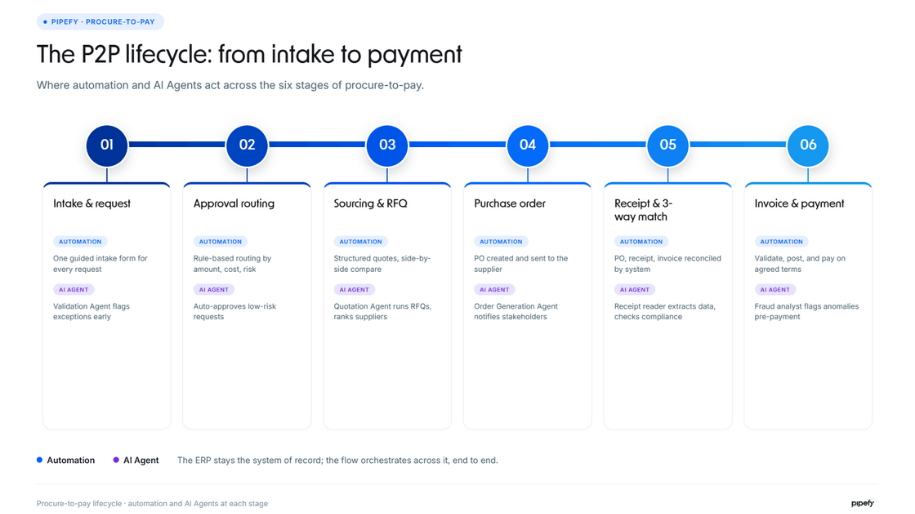
When these stages live in different tools, the process becomes impossible to see and easy to bypass. When they are orchestrated as one flow, each step feeds the next with clean data, and the operation gains the traceability that audits and forecasts depend on.
Read more: Procurement cycle: stages and importance in supply management
Key capabilities of a modern procurement automation platform
Not every tool that touches purchasing qualifies as a true automation platform. A modern solution should cover the lifecycle above and connect it to the systems and policies around it. The capabilities below are the ones that separate a platform from a point tool.
| Capability | What it does |
| Single intake | A guided request form that captures category, budget, cost center, and supplier, replacing email, chat, and PDFs |
| Rule-based approval routing | Deterministic chains by amount, cost center, and risk tier, predictable, auditable, and fast |
| Supplier onboarding and management | One front door for vendors, with verified documents, banking, and compliance attached before the first PO |
| Sourcing and RFQ automation | Structured quote requests, side-by-side comparison, and negotiation captured in the flow |
| Three-way matching | PO, receipt, and invoice reconciled by the system, with exceptions surfaced to AP instead of the reverse |
| AI Agents | Software agents that read documents, classify requests, score risk, and recommend or execute the next step |
| ERP, CLM, and finance integration | Native connectors and APIs that keep the ERP as the system of record while the flow runs on top |
| Analytics and audit trail | Real-time visibility into spend, cycle time, and SLAs, with an immutable log for every action |
The throughline is coordination. A capable P2P software platform does not just digitize isolated tasks; it connects intake, sourcing, supplier data, and payment so the whole process behaves like one system.
Read also: Supplier management automation: streamline your procurement processes
Procurement automation vs traditional P2P software
Here is the distinction that matters most when comparing options. Traditional P2P software and broader source-to-pay suites are organized around modules: a sourcing module, an AP module, a contracts module. They are powerful, but the burden of making the end-to-end process flow across those modules, and across the systems already in place, often falls back on the customer.
The source-to-pay suite market is mature. In its 2025 Magic Quadrant for Source-to-Pay Suites, Gartner evaluated established suites including SAP, Coupa, Ivalua, GEP, and Oracle. These platforms are deep and capable, yet the analysis reflects a market built around suites and modules, while the harder, less-served problem is orchestrating the full flow across whatever systems a company already runs.
That is the difference between automating tasks and orchestrating a process. The table below frames it.
| Dimension | Traditional P2P / source-to-pay software | Procurement automation as orchestration |
| Focus | Modules for sourcing, AP, and contracts | One connected flow from intake to payment |
| Architecture | Often a system of record that wants to own the data | A layer that orchestrates across existing systems |
| AI | Assistance and analytics inside each module | Agents that decide and act within a governed flow |
| Who configures | Frequently IT or specialized admins | No-code, so business teams build and adjust flows |
| Legacy integration | Strongest within the vendor ecosystem | Connects ERP, CLM, and finance without replacing them |
| Compliance and audit | Module-level controls | Policy enforced at intake, with one end-to-end trail |
| Outcome | Faster tasks | Lower cycle time and cost per transaction, with traceability |
This is the underserved angle in most procurement content, and the one that matters for enterprises: connecting procurement automation to compliance, supplier management, and strategic sourcing, rather than treating it as accounts-payable automation alone.
How AI is changing procurement orchestration
AI is what turns a workflow engine into a decision engine. The shift is not about replacing buyers and AP analysts; it is about putting an agent next to every operator and letting the model do the reading, drafting, and pattern-spotting while people set policy and handle judgment calls.
Inside an orchestrated flow, AI Agents already do meaningful work: they read invoices and extract data, classify and route requests, score supplier and request risk, draft RFQs, compare quotes, and recommend the best option against defined criteria. The point is that they operate within the process, with rules and a logged trail, not as a bolt-on chatbot.
The Hackett Group’s 2025 Digital World Class Procurement research found that top-performing procurement functions deliver 2.6 times greater ROI, run 58% shorter requisition-to-PO cycle times, and lose far less in savings to maverick buying and noncompliance than the average operation. Those gains come from process maturity and technology working together, not from AI alone.
That sequence matters, and it is where many programs stumble. As Alessio Alionco, Founder and CEO of Pipefy, puts it: “Most procurement teams don’t have an AI problem. They have a maturity problem. Skipping straight to autonomy on top of broken master data and ad-hoc approvals doesn’t create a smarter P2P, it just creates faster mistakes.”
In practice, AI maturity in procurement tends to climb in stages: first structured intake (digitize and standardize), then compliant sourcing (AI as a copilot for buyers and AP), and finally strategic negotiation (governed agents that source, negotiate within tolerance, and transact end to end). You cannot skip the foundation and survive the top.
Putting that orchestrated flow into practice, from intake to payment, is the discipline of procurement workflow automation.
Learn more: End-to-end supply chain orchestration: how it transforms operational performance in 2026
Integration with ERP, CLM, and finance systems
No procurement operation runs in a vacuum. An ERP, a contract lifecycle management (CLM) tool, supplier portals, and AP systems already exist, and the automation platform has to work with all of them. This is exactly where many projects stall and where the orchestration approach earns its keep.
The principle is simple: orchestrate, do not replace. The ERP stays the system of record for financial data, while the automation layer connects to it through native connectors, APIs, or an iPaaS, and runs the workflow on top. That keeps a single source of truth while removing the manual rekeying that creates errors and delays.
Legacy systems are the real test. A platform that only integrates cleanly with modern, API-first tools will not survive contact with the systems most enterprises actually run. The ability to connect to older ERPs, including heavily customized or end-of-life versions, is often the deciding factor in whether automation reaches the whole process or just the easy parts.
How to evaluate and choose the right P2P platform
Once the concept is clear, the decision becomes practical. The questions below separate a platform that orchestrates the process from a tool that only organizes part of it. They also preview the deeper evaluation covered in the dedicated guide on choosing P2P software.
- Does it orchestrate the full flow from intake to payment, or only automate one leg, such as AP?
- Can business teams build and change workflows in no-code, without an IT project for every adjustment?
- Are there AI Agents that read documents, validate, and act, with audit trails and human review for exceptions?
- Does it connect natively to your ERP, CLM, and finance systems, including legacy versions, without replacing them?
- Is compliance enforced at the point of request, with one end-to-end record for audit?
- How fast is time-to-value, and what does a realistic payback look like in comparable operations?
- Does it scale to new categories, departments, and volumes without re-architecting the operation?
A simple rule of thumb: the more of these a vendor covers in an integrated way, the closer you are to true procurement automation software rather than a stack of tools that do not talk to each other.

How Pipefy orchestrates procurement automation
Pipefy is built for the scenario this guide describes: a layer that orchestrates the end-to-end P2P process rather than another module to manage. With P2P AI Studio, the procurement flow runs from requisition to payment on no-code workflows, connected to the systems you already use and powered by AI Agents that handle the repetitive work.
Those agents are specialists in the procurement process. A validation agent checks requests against policy, budget, and cost center; a quotation agent runs RFQs and builds supplier comparisons; a compliance agent scores risk and produces an audit-ready report; and a negotiation agent runs structured rounds and recommends the best supplier.
Since the platform is no-code, business teams configure and evolve the flows without queuing IT change requests, while the ERP stays the system of record. You can see the full set on Pipefy’s procurement AI Agents page.
The results show up in the numbers. The Total Economic Impact study by Forrester found 260% ROI and payback in under 6 months for Pipefy customers.
Success Story: How Samsonite built an error-proof procurement process and achieved 177% ROI with Pipefy
Samsonite is a clear example. The consumer-goods maker reached 177% ROI, saved more than 2,370 hours in five months, and now manages 100% of requests in Pipefy, all while integrating with a legacy Oracle J.D. Edwards ERP that most tools could not connect to.
This orchestration-first approach is also where the market is heading. Pipefy was named an Illustrative Provider in Gartner’s 2026 report Emerging Tech: AI Vendor Race, on agentic orchestration platforms.
Book a demo to see how Pipefy orchestrates procurement automation on your own processes.
FAQ — Frequently asked questions about procurement automation
What is procurement automation?
Procurement automation is the use of software, workflow rules, and AI to run the procurement process end to end, from purchase request and approval through sourcing, purchase order, receipt, and payment. It replaces manual steps such as email approvals and invoice keying with a standardized, traceable flow.
What is the difference between procurement automation and P2P software?
Traditional P2P software is usually organized around modules for sourcing, AP, and contracts. Procurement automation, in the orchestration sense, connects those steps and the systems around them into one end-to-end flow, with AI acting inside the process. The difference is automating tasks versus orchestrating a process.
What does procure-to-pay (P2P) mean?
Procure-to-pay, also called purchase to pay, is the full cycle that begins when someone requests a purchase and ends when the supplier is paid. It spans intake, approval, sourcing, purchase order, receipt, three-way match, and invoice payment.
How does AI fit into procurement automation?
AI Agents work inside the workflow to read and validate documents, classify and route requests, score risk, draft RFQs, compare quotes, and recommend or execute the next step, always with rules, audit trails, and human review for exceptions. The goal is to make people faster and more consistent, not to remove oversight.
Does procurement automation replace the ERP?
No. The most effective approach orchestrates across the ERP rather than replacing it. The ERP remains the system of record for financial data, while the automation layer connects to it and runs the workflow on top, including with legacy ERP versions.
How long does it take to see results?
It varies by scope, but a sound implementation is incremental: start with one high-volume process, prove value, then expand. Many operations see measurable gains in cycle time and cost within the first few months rather than after a multi-year project.
See where your P2P process stands
Procurement automation is not a single purchase; it is a path from a fragmented, manual process to an orchestrated flow that the business can see, trust, and scale. The operations that win treat it that way, sequencing intake, sourcing, and payment, and measuring the result at each step.
If you want to pressure-test your own operation, the companion guide on orchestrating the workflow from intake to payment walks through it stage by stage, and a short demo will show the difference between a tool that registers requests and one that runs the process.